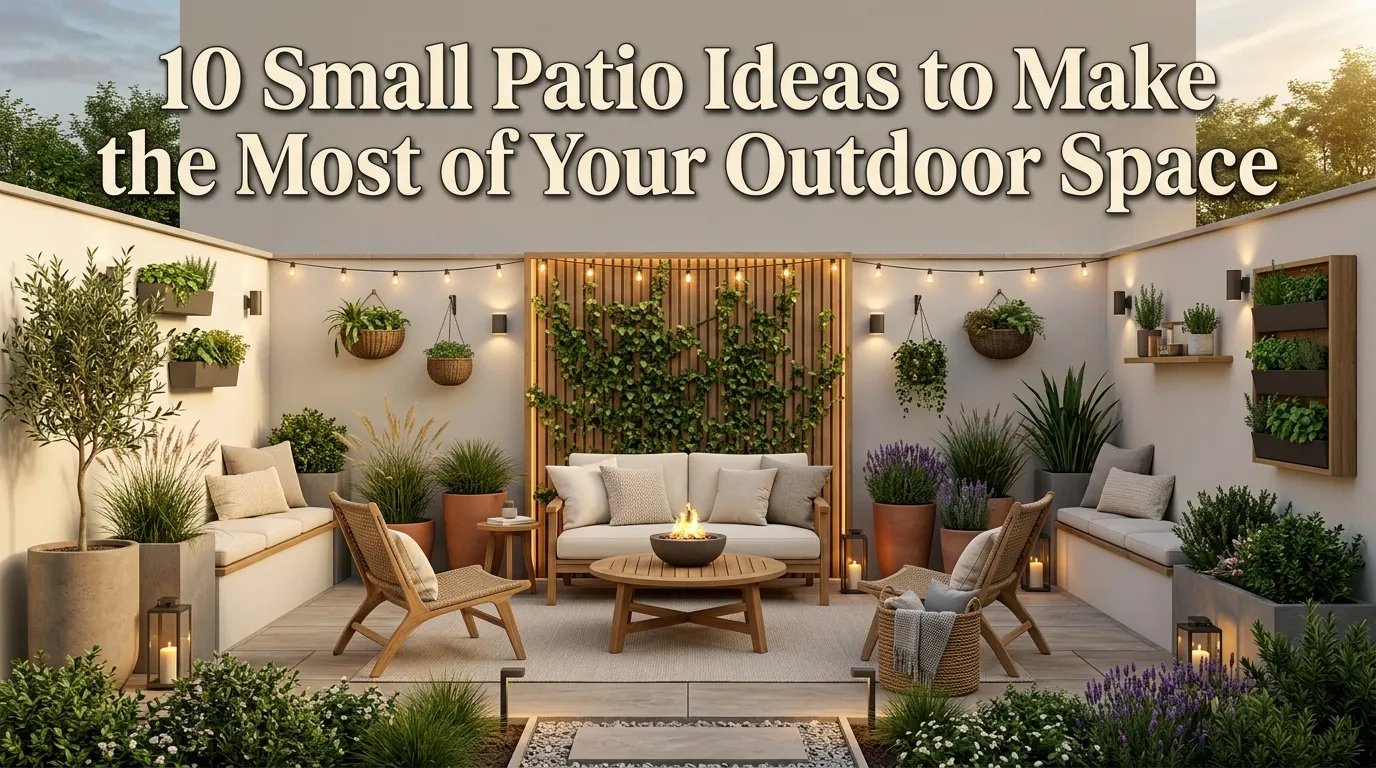
10 Small Patio Ideas to Make the Most of Your Outdoor Space
A small patio can be one of the most useful spaces in a home when it’s planned around the way you actually live. You don’t need a sprawling backyard or a huge outdoor furniture collection to create a comfortable place for morning coffee, casual meals, reading, or relaxing at the end of the day.
The challenge with a compact patio is choosing what deserves the limited floor space. A large dining set might look beautiful in a showroom but leave little room to walk. Too many planters can make a patio feel crowded, while too little furniture can make it feel unfinished. The goal is finding a balance between comfort, movement, storage, and visual simplicity.
I’ve found that small outdoor spaces often benefit from the same principle used in well-designed small rooms: give every item a purpose. A bench can provide seating and storage. A narrow table can work as a dining surface and serving station. Wall-mounted planters can introduce greenery without taking up floor space.
The best small patios also make use of vertical space. Pergolas, privacy screens, trellises, hanging planters, and wall lighting can add personality without consuming valuable floor area.
Below, you’ll find practical ideas for making a compact patio feel comfortable, attractive, and intentional. Some work for homeowners with permanent patios, while others can be adapted to rental-friendly outdoor spaces.
Whether your patio is a tiny concrete slab, a narrow space beside the house, or a small paved corner in the backyard, these ideas can help you create an outdoor area you’ll actually want to use.
Table of Contents
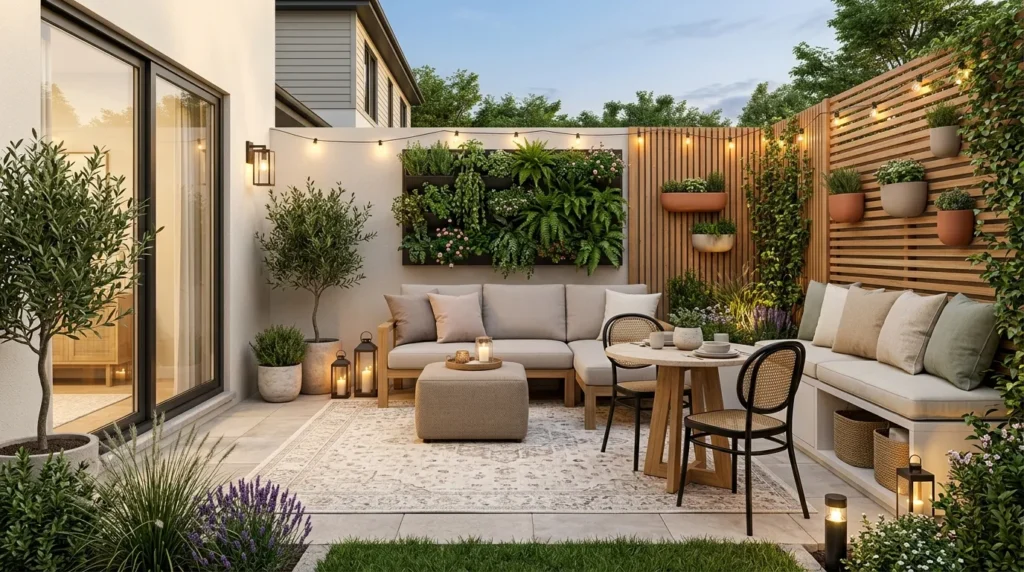
1. Compact Bistro Set
Create a simple dining and coffee spot with furniture scaled specifically for small spaces.
2. Built-In Bench
Maximize seating along a wall or fence while keeping the center of the patio open.
3. Vertical Garden
Bring greenery into a compact patio by using walls, trellises, and vertical planters.
4. Foldable Furniture
Keep the patio flexible with furniture that can be folded or moved when extra space is needed.
5. Cozy Lounge Corner
Turn one corner into a comfortable retreat with a compact chair, loveseat, and small table.
6. Outdoor Rug Zone
Use a weather-appropriate rug to visually define a small seating area.
7. Slim Dining Table
Make outdoor meals practical with a narrow table that leaves room for circulation.
8. Pergola Retreat
Use a small overhead structure to give the patio the feeling of an outdoor room.
9. Hanging Chair
Add a comfortable statement seat while keeping most of the floor space available.
10. Layered Small Patio
Combine furniture, plants, lighting, and accessories carefully for a polished compact retreat.
1. Compact Bistro Set
Quick Benefits
- Perfect for two people
- Uses minimal floor space
- Great for morning coffee
- Easy to rearrange
- Works with many patio styles
Why It Works
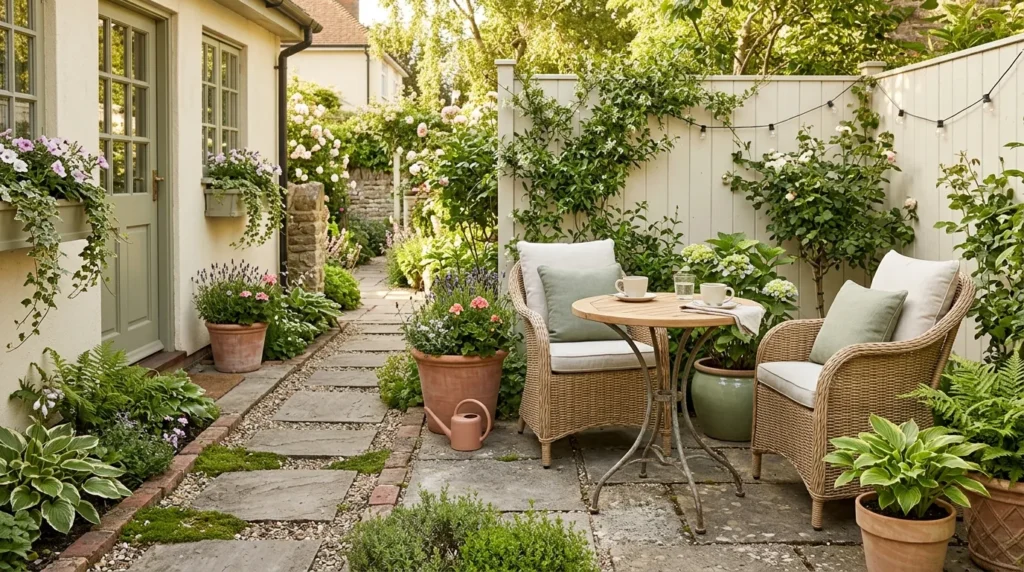
A bistro set is one of the simplest ways to make a small patio useful without overwhelming it. Because the table and chairs are designed on a smaller scale, they can provide a comfortable place to sit while leaving enough room for movement.
This arrangement works particularly well for couples, solo homeowners, or anyone who enjoys using the patio for coffee, breakfast, reading, or quiet conversation.
The key is choosing furniture that is genuinely compact rather than simply selecting a standard dining set and pushing it against a wall.
A round table can sometimes make movement around a small seating area easier because there are no sharp corners projecting into walking paths.
How To Style It
Place the bistro set near the edge of the patio or beside a garden view.
Add one medium-sized planter rather than several small pots that create visual clutter.
For a cottage-inspired look, choose a classic metal set surrounded by flowering plants.
For a modern patio, use clean-lined furniture in black, white, natural wood, or neutral tones.
Keep the tabletop relatively clear. A small planter or simple centerpiece is enough.
2. Built-In Bench
Quick Benefits
- Saves floor space
- Provides generous seating
- Works along walls and fences
- Can include storage
- Creates a permanent focal point
Why It Works
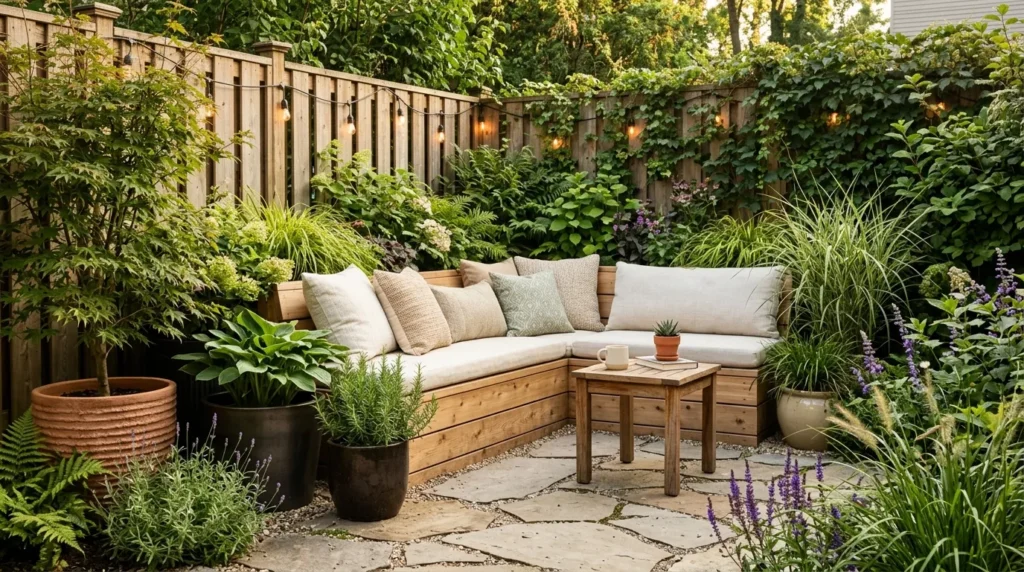
When floor space is limited, perimeter seating is often more efficient than placing chairs in the middle of the patio.
A built-in bench can run along a fence or exterior wall while leaving the center open for a small table or flexible seating.
It also creates a strong visual boundary. Instead of seeing a collection of individual furniture pieces, the patio feels more intentionally designed.
If properly constructed, the space beneath the bench can sometimes provide storage for cushions or outdoor accessories. Any storage should be designed to handle exterior conditions appropriately.
How To Style It
Use a simple wood, composite, masonry, or other suitable outdoor material that coordinates with the home’s exterior.
Add weather-resistant cushions to make the bench more comfortable.
Place one or two small side tables nearby rather than a large coffee table.
Vertical greenery behind the bench can soften a fence or wall and make the seating feel more private.
Keep the center of the patio open so the area remains easy to navigate.
3. Vertical Garden
Quick Benefits
- Adds greenery without using much floor space
- Creates privacy
- Adds visual height
- Works with small patios
- Can soften hard surfaces
Why It Works
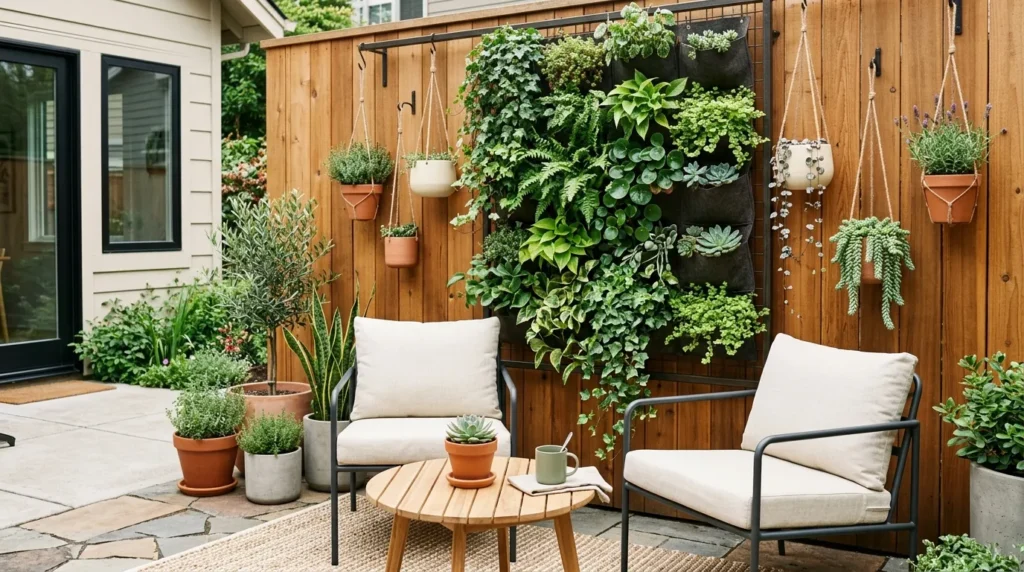
Small patios often have more unused wall space than unused floor space.
A vertical garden takes advantage of that overlooked area. Trellises, wall-mounted planters, hanging containers, and narrow plant stands can introduce greenery while preserving valuable walking space.
Vertical planting also changes the proportions of a compact patio. Instead of everything sitting at ground level, plants draw the eye upward and make the space feel more layered.
The plants you choose should be appropriate for your local climate, available sunlight, and watering conditions.
How To Style It
Choose one main vertical planting feature rather than covering every wall.
A wooden trellis with climbing greenery can create a natural backdrop.
For a modern patio, use a structured vertical planter with simple foliage.
Place taller plants toward the back and smaller containers closer to the seating area.
Avoid creating a wall of dense plants if the patio is already narrow. Some open space helps maintain an airy appearance.
4. Foldable Furniture
Quick Benefits
- Saves space when not in use
- Flexible for entertaining
- Easy to rearrange
- Useful for renters
- Works in very small patios
Why It Works
Flexibility is especially valuable when every square foot matters.
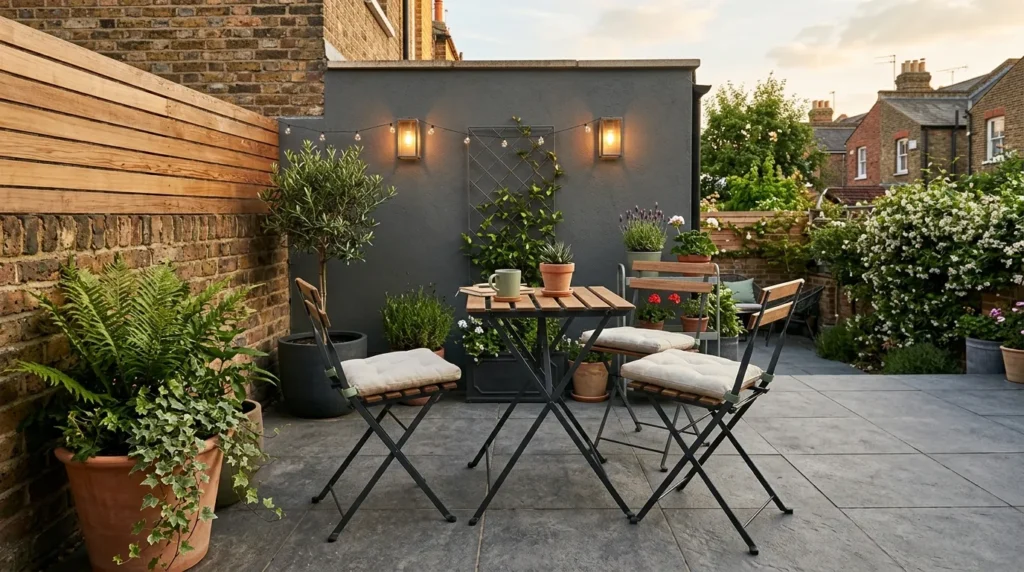
Foldable chairs and tables allow you to create a seating arrangement when you need it and open the patio when you don’t.
This is useful for homeowners who use their patio for multiple activities. You might want a table for weekend breakfast but need an open surface for gardening or other projects later.
Lightweight movable furniture can also make seasonal cleaning easier.
How To Style It
Choose one consistent material or finish so the furniture doesn’t look temporary.
Wood folding chairs can create a warm traditional appearance, while powder-coated metal furniture often feels more contemporary.
Keep a narrow storage area nearby for folded pieces.
Add cushions only when you’re using the furniture to prevent the patio from becoming visually crowded.
A foldable bistro table paired with two chairs can be enough for a surprisingly functional outdoor space.
5. Cozy Lounge Corner
Quick Benefits
- Creates a relaxing retreat
- Works in narrow patios
- Encourages everyday use
- Doesn’t require many pieces
- Easy to personalize
Why It Works
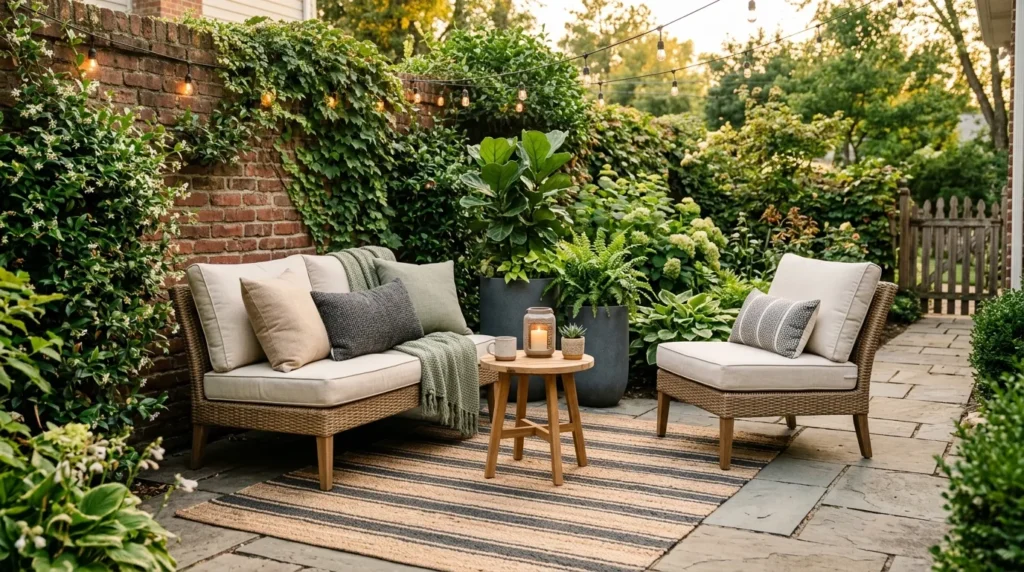
A small patio doesn’t necessarily need a dining area. If you prefer relaxing outdoors, use the available space to create a comfortable lounge corner instead.
A compact loveseat, lounge chair, or even one comfortable armchair can become the focal point.
The important thing is to define the purpose of the corner. When seating, a small table, lighting, and greenery are arranged together, even a modest space can feel like a separate outdoor room.
How To Style It
Place the main seating along one side of the patio.
Add a small side table for drinks or books rather than a large coffee table.
Use an outdoor rug to visually anchor the arrangement if there is enough room.
A tall planter or narrow trellis can provide a sense of enclosure.
Keep the color palette simple—cream, beige, natural wood, muted green, and charcoal work especially well in small spaces.
6. Outdoor Rug Zone
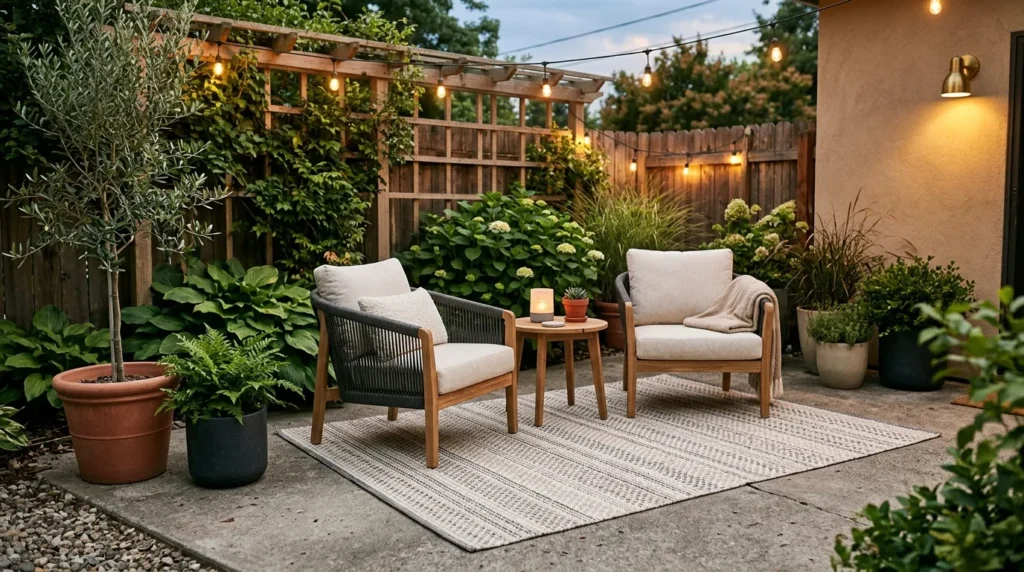
Quick Benefits
- Defines the seating area
- Adds texture
- Introduces color
- Makes concrete patios feel softer
- Helps furniture feel coordinated
Why It Works
A small patio can sometimes feel like a collection of unrelated objects sitting on a hard surface.
An appropriately designed outdoor rug visually connects the furniture and creates a clear seating zone.
This is especially helpful when you have a loveseat or two chairs that otherwise look disconnected from the rest of the patio.
The rug doesn’t need to cover the entire patio. In fact, leaving some surrounding flooring visible can make the space feel larger.
Choose a product specifically intended for outdoor conditions and follow its care instructions.
How To Style It
Select a rug that is large enough to visually connect the primary seating pieces without overwhelming the floor.
Neutral patterns can create subtle texture, while a geometric pattern can give a modern patio more personality.
Pair the rug with cushions in one or two coordinating colors.
Avoid using too many patterns in a tiny space. One patterned element surrounded by simpler pieces usually feels more polished.
7. Slim Dining Table
Quick Benefits
- Makes outdoor dining possible
- Works in narrow patios
- Maximizes wall-side space
- Useful for entertaining
- Provides a multipurpose surface
Why It Works
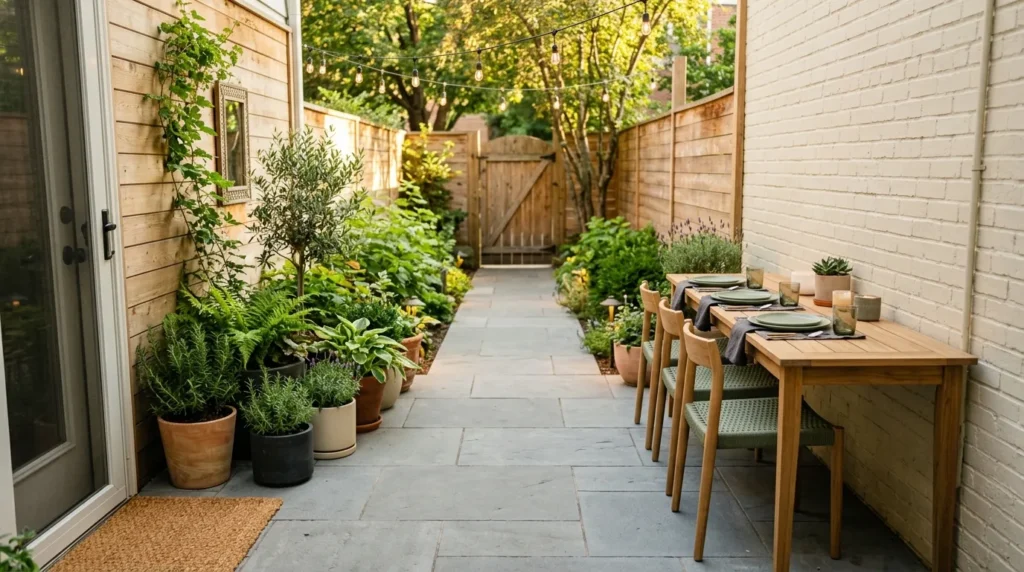
A narrow patio doesn’t have to mean giving up outdoor dining.
A slim rectangular table can fit along one side of the space while leaving a clear walking path.
This arrangement works particularly well when the patio is long and narrow rather than square.
The table can also serve multiple purposes. Outside of mealtimes, it can become a workspace, gardening surface, or place for morning coffee.
How To Style It
Position the long side of the table parallel to the patio’s longest wall.
Choose chairs that can tuck fully underneath when they’re not being used.
A bench on one side can sometimes be more space-efficient than two individual chairs.
Keep the table centerpiece low. A narrow planter or small vase is enough.
If the patio receives strong sunlight, consider a suitable shade solution that doesn’t interfere with circulation.
8. Pergola Retreat
Quick Benefits
- Adds vertical structure
- Defines the patio
- Can support shade
- Creates an outdoor-room feeling
- Provides a place for lighting
Why It Works
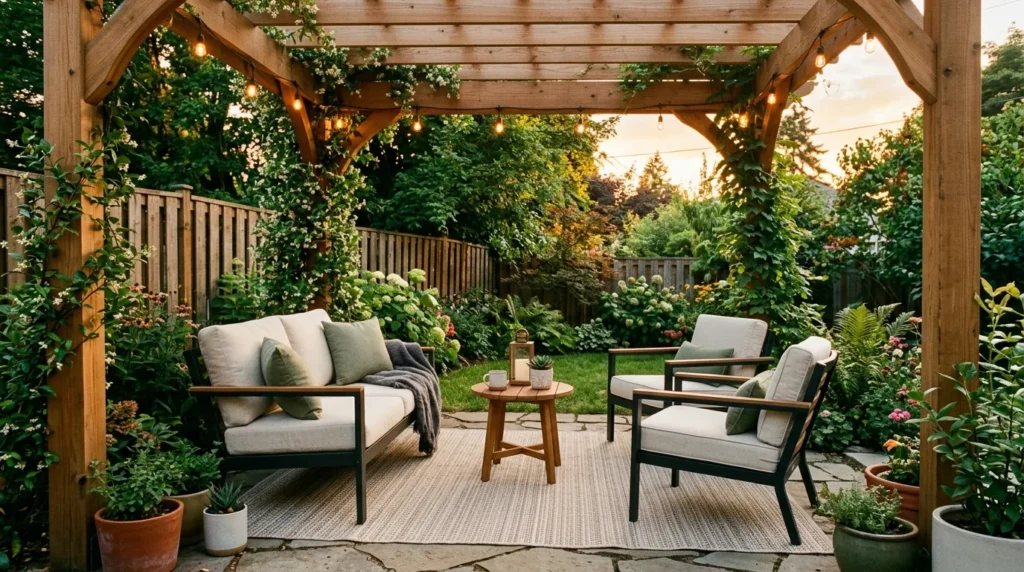
A small pergola can make a compact patio feel much more intentional.
The overhead structure establishes a visual boundary without requiring walls. It can also provide a framework for suitable outdoor lighting, climbing plants, or other shade elements.
The goal isn’t to make the patio feel enclosed. Instead, the pergola gives the seating area a stronger sense of identity.
Scale is important. A structure that’s too large can make a small patio feel compressed.
How To Style It
Choose a simple design that fits the patio dimensions and home’s architecture.
Place a loveseat, compact dining set, or two lounge chairs beneath it.
Add climbing greenery selectively rather than covering every beam.
Warm outdoor lighting can make the structure particularly attractive in the evening.
If shade is the primary goal, choose a design and covering appropriate for the structure and local weather conditions.
9. Hanging Chair
Quick Benefits
- Creates a personal retreat
- Uses vertical space
- Adds personality
- Ideal for reading
- Can reduce the need for multiple chairs
Why It Works
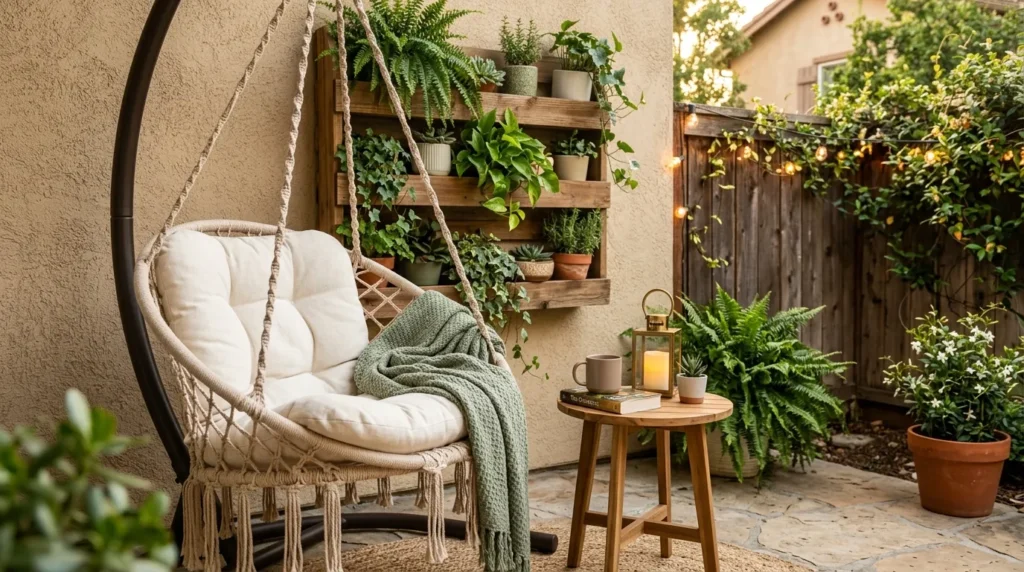
A hanging chair can be an excellent solution when you want a comfortable seating option without filling the patio with traditional furniture.
Because the chair occupies vertical space, much of the floor underneath can remain visually open.
It’s especially useful for a quiet reading corner or a place to enjoy morning coffee.
The support system is critical. Hanging furniture should only be attached to a structure designed and rated for its load, following manufacturer instructions. Freestanding versions can provide another option.
How To Style It
Place the chair near a garden view or beside a vertical planting feature.
Add one comfortable outdoor cushion and a small side table.
Keep surrounding furniture minimal so the chair remains the focal point.
A nearby lantern or suitable wall light can make the corner inviting after sunset.
10. Layered Small Patio
Quick Benefits
- Makes the space feel complete
- Combines function and style
- Creates visual depth
- Maximizes limited space
- Works with many design styles
Why It Works
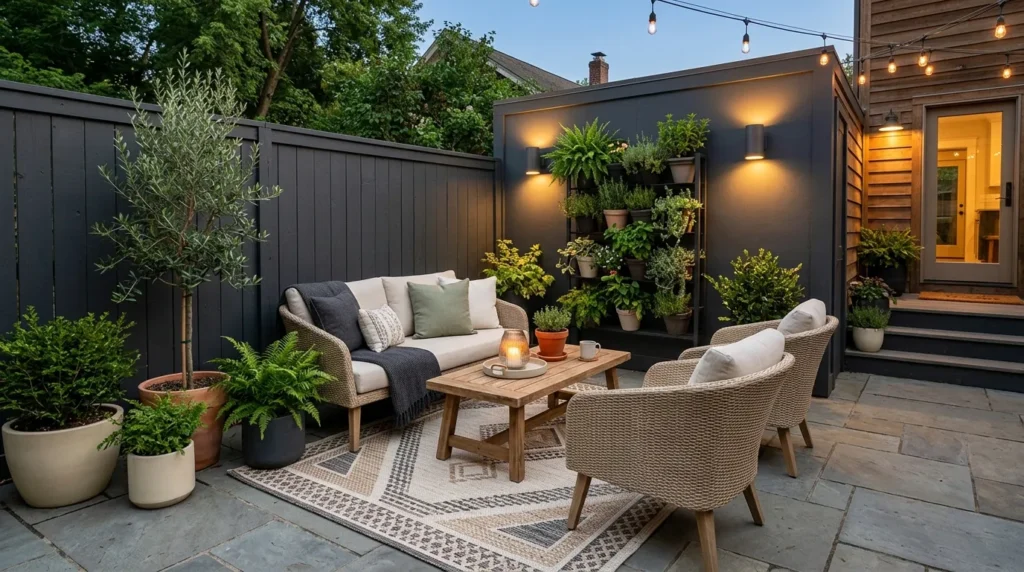
The most successful small patios rarely depend on one clever furniture piece. Instead, they combine several small decisions that work together.
Furniture establishes the main function. A rug defines the seating area. Plants add softness. Lighting extends usability into the evening. Vertical elements create height.
The trick is restraint.
Every item should have a reason for being there. If a planter blocks a walkway or an oversized chair makes the patio difficult to navigate, the decoration isn’t helping the space.
How To Style It
Start with your primary piece of furniture.
Then add one vertical element, such as a trellis or tall planter.
Introduce a small table or storage piece.
Finish with lighting and one or two decorative details.
Keep the palette consistent throughout the space. Repeating two or three materials—such as natural wood, black metal, and greenery—can make a small patio feel cohesive.
How To Make a Small Patio Feel Bigger
The easiest way to make a small patio feel larger is to protect open floor space.
Avoid filling every corner with furniture and accessories.
Use furniture with exposed legs when possible. Seeing more of the floor underneath chairs and tables can create a lighter visual effect.
Vertical elements are also useful. Tall plants, trellises, privacy screens, and pergolas draw attention upward.
Keep the color palette relatively simple. Similar tones across furniture, walls, and accessories can make the patio feel less visually fragmented.
Finally, maintain clear pathways. A patio doesn’t feel spacious when guests have to navigate around furniture.
Best Furniture for Small Patios
Look for pieces that are proportional to the space.
Good options include:
- Bistro tables
- Loveseats
- Folding chairs
- Compact lounge chairs
- Built-in benches
- Narrow dining tables
- Small nesting tables
- Storage benches
Avoid buying furniture based solely on its appearance in a large showroom.
Measure the patio first.
Then measure the furniture, including the space required to pull out chairs and open doors.
Small Patio Ideas on a Budget
A small patio can be refreshed without replacing everything.
Start by rearranging what you already own.
Then add one high-impact element, such as an outdoor rug, planter, lighting, or comfortable chair.
Secondhand furniture can also work when its construction and materials are suitable for outdoor use.
Painting or refinishing certain outdoor-safe surfaces may change the appearance dramatically, but make sure the product is appropriate for the material and exterior conditions.
Plants are another relatively simple way to change the mood. A few large planters can often create more impact than many small pots.
How To Add Privacy to a Small Patio
Privacy is especially important when a patio is close to neighboring homes.
A trellis with suitable climbing plants can create a softer visual barrier.
A privacy screen or fence can provide a more immediate solution.
Tall planters can also help define the edge without requiring permanent construction.
The goal is to block unwanted views without making the patio feel enclosed.
Use a combination of vertical greenery and open sections when possible so natural light can still reach the seating area.
Small Patio Lighting
Lighting can make a compact patio feel much more inviting after sunset.
Wall sconces can provide useful illumination without taking up floor space.
String lights can create a cozy overhead layer when there is a suitable structure for them.
Small lanterns can add warmth to a table or seating area.
Low landscape lights can highlight nearby plants or pathways.
Keep the lighting soft and purposeful rather than trying to make every corner equally bright.
Common Small Patio Mistakes
One of the most common mistakes is choosing furniture that’s too large.
Another is trying to create too many functions in one tiny area.
A patio that contains a dining table, sectional, fire pit, multiple planters, storage, and several decorative pieces may quickly become difficult to use.
Don’t forget the walking path.
Also consider door swings, gates, stairs, and access to outdoor equipment.
Finally, avoid using every inch of available space. A little empty space can make the entire patio feel more comfortable.
FAQ
How do I make a small patio look bigger?
Keep the center of the patio as open as possible and choose furniture that fits the scale of the space. Use vertical planters, trellises, and lighting to draw the eye upward. A consistent color palette and clearly defined seating zone can also make the patio feel more organized and spacious.
What furniture is best for a small patio?
Compact furniture such as bistro sets, loveseats, folding chairs, built-in benches, and narrow tables tends to work well. Choose pieces based on actual measurements rather than appearance alone. Make sure there is enough room to pull out chairs and move comfortably around the seating area.
How can I decorate a small patio without making it look cluttered?
Choose a few purposeful pieces rather than filling every available surface. Start with seating, then add one rug, a few plants, suitable lighting, and perhaps a small table. Repeating materials and colors can also make the space feel more cohesive.
Can I put a dining table on a small patio?
Yes. A narrow rectangular table, compact round table, or bistro set can work well depending on the dimensions. Folding furniture can provide additional flexibility. Measure the space needed for chairs to move in and out before purchasing a table.
How can I add privacy to a small patio?
Trellises, privacy screens, fencing, tall planters, and suitable climbing plants can all help. Combine solid and open elements so the patio doesn’t feel boxed in. Choose plants appropriate for the amount of sunlight and climate conditions.
What colors work best for a small patio?
There isn’t one required palette, but lighter neutrals, natural wood, soft greens, and restrained accent colors can create an airy appearance. Darker furniture can also work beautifully when balanced with lighter walls, cushions, or surrounding greenery.
How can I make a small patio cozy at night?
Use several gentle layers of lighting instead of one very bright fixture. Wall lights, string lights, lanterns, and subtle landscape lighting can create depth. Add comfortable cushions and keep a clear, uncluttered seating arrangement so the space remains functional after sunset.
Conclusion
A small patio doesn’t need to compete with a large backyard to be useful or beautiful.
The most effective designs focus on proportion, purpose, and flexibility. A compact bistro set can create a lovely breakfast spot, while a built-in bench can provide generous seating without occupying the center of the patio. Vertical gardens make use of walls, and foldable furniture allows the space to change throughout the day.
The key is resisting the temptation to fill every inch.
Choose the activity you want to enjoy most, build the patio around that purpose, and then add a few carefully selected details. Comfortable seating, greenery, lighting, and a cohesive color palette can make a surprisingly small area feel like a genuine outdoor retreat.
Start with one or two ideas rather than trying to implement everything at once. Once you see how your patio functions in real life, you’ll know what it actually needs.
With thoughtful planning, even a narrow patio or tiny paved corner can become one of the most enjoyable spaces around your home.
Related Articles
- 10 Backyard Seating Ideas for a Cozy Outdoor Retreat
- 10 Outdoor Lighting Ideas for a Beautiful Backyard
- 10 Backyard Fire Pit Ideas for Cozy Evenings
- 11 Backyard Privacy Ideas for a More Secluded Space
- 12 Backyard Decor Ideas for Comfortable Outdoor Living