10 Outdoor Lighting Ideas to Make Your Backyard Feel Warm and Inviting
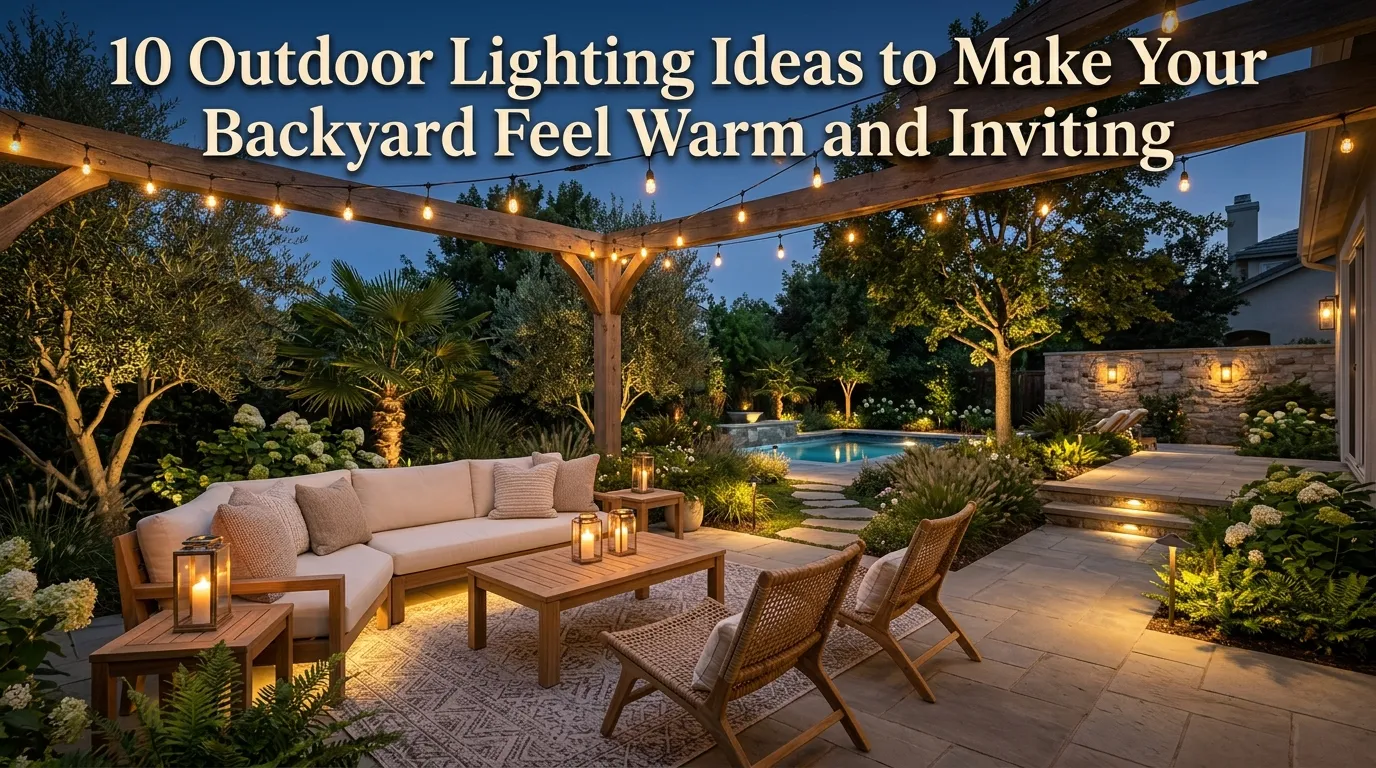
Outdoor lighting can completely change the way a backyard feels after sunset. A patio that looks ordinary during the day can become warm and welcoming with a few thoughtfully positioned lights, while pathways, trees, garden beds, and architectural details can take on an entirely different character at night.
The best outdoor lighting isn’t necessarily the brightest. In fact, one of the most common mistakes homeowners make is trying to illuminate everything equally. A more successful approach is to combine different levels of light so the eye naturally moves through the space. Soft lighting near seating creates comfort, pathway lights improve navigation, and subtle accent lighting can highlight plants or architectural features.
I’ve noticed that outdoor spaces feel much more polished when lighting is planned alongside the landscape rather than added as an afterthought. A beautiful tree may need only one carefully positioned uplight. A dining area may need a warm overhead fixture rather than several bright spotlights. Even a simple walkway can look dramatically better when lights are evenly spaced.
Safety is important too. Outdoor electrical products should be rated for their intended location, and permanent electrical installations should follow applicable local requirements and be handled appropriately.
The ideas below range from simple string lights and lanterns to more layered landscape lighting. Whether you’re updating a small patio, refreshing a backyard, or creating an inviting entertaining area, these approaches can help you make your outdoor space useful and beautiful well after dark.
Table of Contents
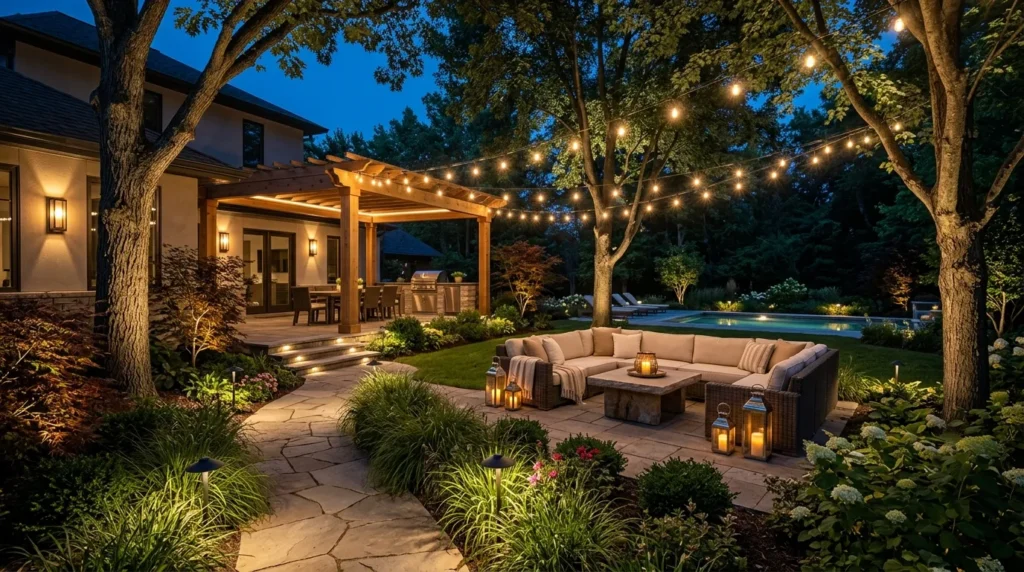
1. String Light Canopy
Create a cozy ceiling of warm illumination above patios, decks, and entertaining areas.
2. Pathway Lighting
Use low-level fixtures to make garden paths and walkways easier to navigate at night.
3. Tree Uplighting
Highlight mature trees and architectural branches with carefully positioned landscape lights.
4. Lantern Clusters
Combine decorative lanterns at different heights for a relaxed, layered glow.
5. Pergola Lighting
Turn a pergola into a comfortable outdoor room with integrated overhead lighting.
6. Step Lighting
Add subtle illumination to stairs and changes in elevation for practical nighttime visibility.
7. Garden Accent Lights
Bring flower beds, shrubs, and landscape features into the evening design.
8. Wall Sconces
Use exterior wall fixtures to illuminate patios, doors, and architectural features.
9. Poolside Glow
Create a calm atmosphere around swimming pools and outdoor lounging areas.
10. Layered Landscape Lighting
Combine several lighting techniques for a polished backyard that feels balanced after dark.
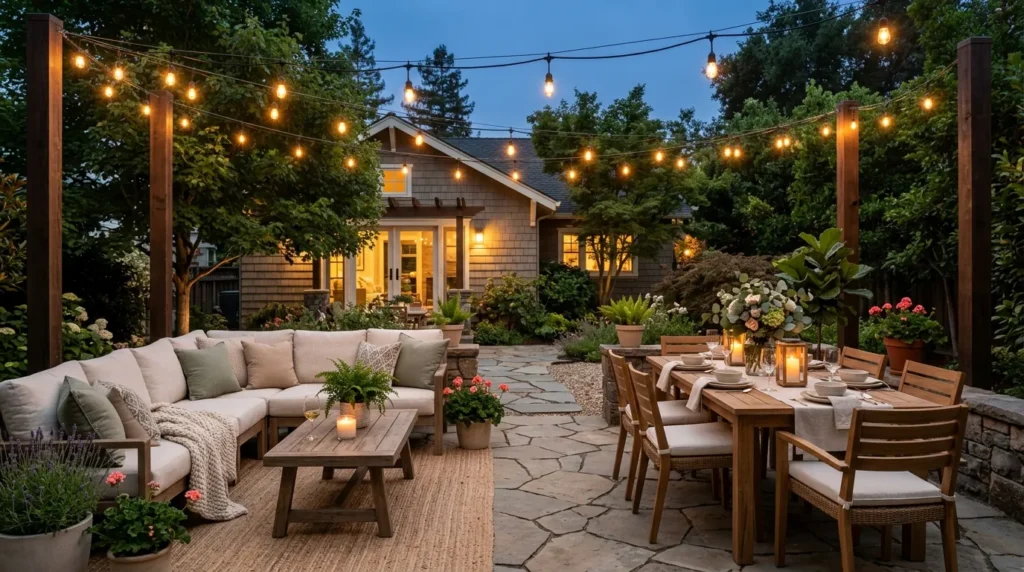
1. String Light Canopy
Quick Benefits
- Creates an inviting atmosphere
- Works well over patios and decks
- Relatively simple to install
- Adds vertical interest
- Perfect for outdoor entertaining
Why It Works
A string light canopy is one of the easiest ways to make an outdoor seating area feel like a destination. Instead of leaving the overhead space completely dark, the lights create a visual ceiling that defines the patio and gives the area a cozy sense of enclosure.
Warm-white bulbs tend to work particularly well for entertaining areas because they create a softer atmosphere than extremely bright outdoor fixtures. The exact appearance will depend on bulb type, spacing, brightness, and the surrounding surfaces.
The key is to avoid making the lights too dense. A few well-spaced strands can look elegant, while an excessive number can create visual clutter and too much brightness.
String lights also work particularly well in backyards where there isn’t an existing ceiling or permanent overhead fixture. They can be arranged between suitable structures, posts, pergolas, or other properly supported attachment points.
How To Style It
Start by defining the area you want to illuminate. A rectangular arrangement over a dining table creates a more structured look, while diagonal strands can feel relaxed and informal.
Pair the lights with warm wood furniture, neutral cushions, outdoor rugs, and greenery. If your patio already has a pergola, run the strands along its beams for a more integrated appearance.
For a small patio, don’t cover the entire yard. Concentrate the lights above the seating area so the brightest visual attention remains where people gather.
Always use outdoor-rated lighting products and suitable supports. Avoid allowing electrical cords to create trip hazards or placing equipment where it can be exposed to conditions it isn’t designed to handle.
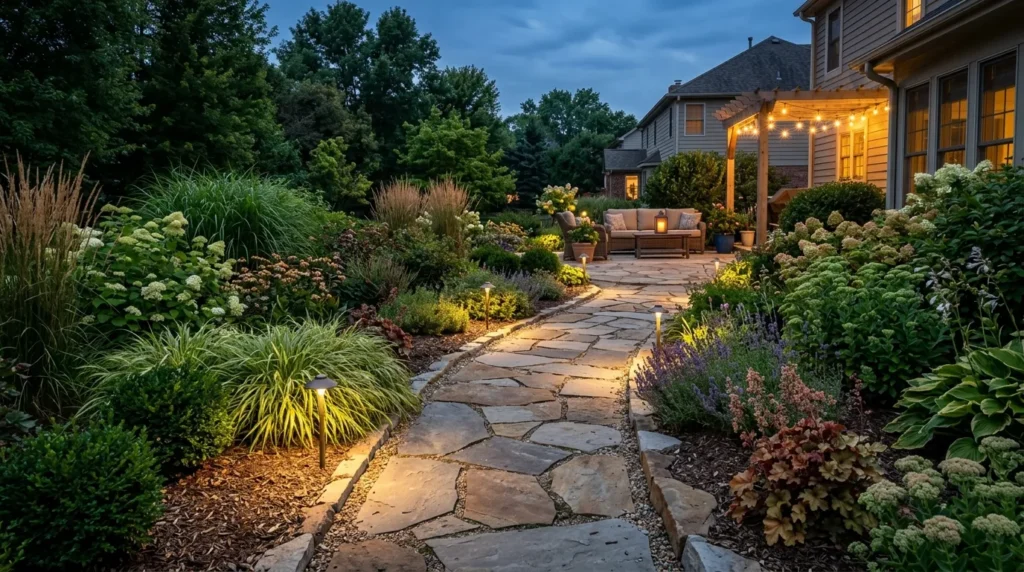
2. Pathway Lighting
Quick Benefits
- Improves nighttime visibility
- Defines walkways
- Adds landscape structure
- Highlights garden borders
- Creates a welcoming entrance
Why It Works
Pathway lighting serves both a practical and decorative purpose. A dark walkway can be difficult to navigate after sunset, while carefully positioned low-level lights create a gentle visual guide through the landscape.
The most attractive pathway lighting usually isn’t overpowering. You want enough illumination to identify the path, steps, and changes in elevation without turning the entire garden into a brightly lit corridor.
Spacing is important. Fixtures that are placed too closely together can create an unnecessarily bright line, while excessive gaps may leave dark areas.
Path lights can also help define garden borders. When positioned near planting beds, their glow can illuminate nearby foliage and create depth beyond the path itself.
How To Style It
Choose fixtures that complement your home’s exterior and landscaping. Simple metal fixtures can work well in contemporary yards, while lantern-inspired designs suit traditional or cottage gardens.
Avoid lining both sides of a narrow path with perfectly symmetrical lights unless that formal appearance is intentional. Alternating fixtures from side to side can create a more natural garden feel.
Use pathway lighting near entrances, steps, patios, and transitions between different outdoor areas.
If the path passes through dense planting, allow some foliage to remain between fixtures. This creates a layered effect rather than making the lighting look like a row of isolated objects.
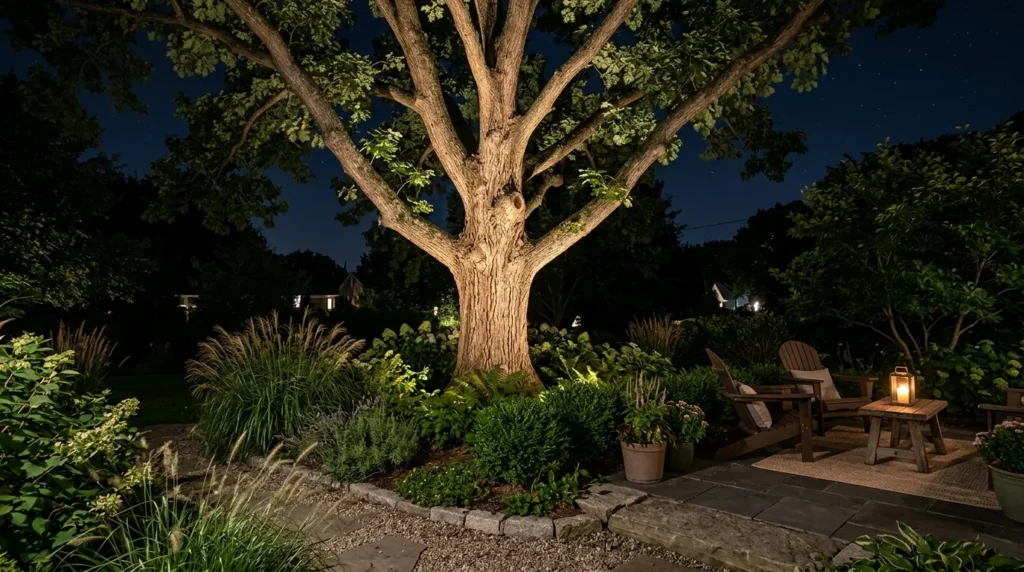
3. Tree Uplighting
Quick Benefits
- Highlights mature trees
- Creates dramatic shadows
- Adds nighttime depth
- Makes landscaping visible after dark
- Works with simple fixtures
Why It Works
Trees can become some of the most beautiful features in a backyard at night when they’re illuminated from below.
Uplighting directs light upward toward the trunk and branches, emphasizing form and texture that may disappear after sunset. A mature tree with an interesting trunk or canopy can become a natural focal point without requiring elaborate decoration.
One fixture may be enough for a smaller tree, while a larger specimen may benefit from multiple carefully positioned lights.
The goal isn’t to flood the entire tree with intense brightness. Subtle illumination often produces a more sophisticated result, particularly when portions of the canopy remain in shadow.
How To Style It
Position fixtures so they highlight interesting trunk shapes or major branches. Experiment with placement before permanently installing anything.
Uplighting looks especially attractive when the tree is surrounded by darker planting. The illuminated foliage becomes a natural backdrop for nearby seating.
For a modern landscape, keep fixtures discreet and let the tree remain the focus. In a cottage or traditional garden, combine tree lighting with pathway fixtures and lanterns.
Avoid placing lights where they’re likely to shine directly into windows or seating areas.
4. Lantern Clusters
Quick Benefits
- Adds decorative warmth
- Works without permanent wiring
- Easy to rearrange
- Suitable for patios and tables
- Creates a relaxed atmosphere
Why It Works
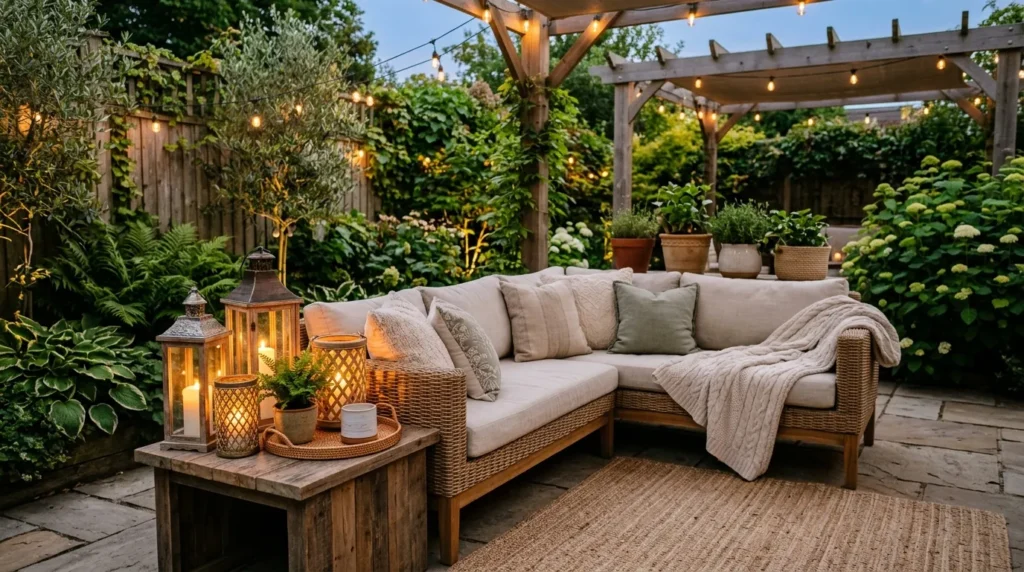
Lanterns are a simple way to introduce lighting at a lower level. Instead of illuminating the entire backyard, they create small pools of light around seating areas, tables, steps, or garden corners.
Using several lanterns at different heights creates more visual interest than placing identical fixtures in a straight line.
This is particularly useful for homeowners who want to experiment with outdoor lighting before committing to permanent installation.
Depending on the product, lanterns may use candles, battery-powered lights, or other light sources. For outdoor use, choose products appropriate for the conditions and follow manufacturer instructions.
How To Style It
Group three lanterns of different heights beside a patio sofa or outdoor dining area.
Use natural materials such as wood, metal, woven textures, or glass to coordinate with your existing decor.
For a modern look, choose simple geometric lanterns. For a farmhouse or cottage-inspired backyard, lanterns with traditional silhouettes can feel more natural.
Avoid placing too many lights on one table. A small cluster often looks more intentional than a crowded collection.
5. Pergola Lighting
Quick Benefits
- Creates an outdoor-room feeling
- Adds overhead illumination
- Works for dining and lounging
- Enhances architectural structure
- Can combine several lighting types
Why It Works
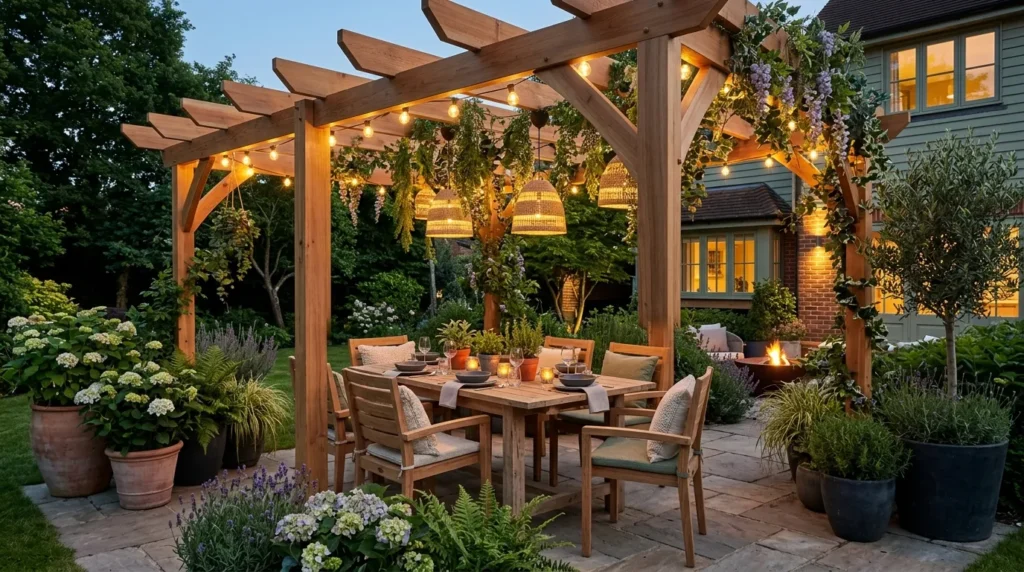
A pergola naturally provides a framework for outdoor lighting. Its beams and posts create convenient places for suitable fixtures, while the structure itself already defines a gathering area.
Instead of treating the pergola as simply a shade structure, use lighting to make it functional after sunset.
Small fixtures attached appropriately to beams can provide focused illumination over a dining table. String lights can create a softer atmosphere, while wall-style or post-mounted fixtures can illuminate the perimeter.
Layering these sources allows you to change the atmosphere depending on what you’re doing. Dinner may need more focused light, while evening conversation may benefit from a softer glow.
How To Style It
Start with the primary activity beneath the pergola.
For dining, place the strongest useful illumination near the table. For lounging, keep the lighting softer and distribute it around the perimeter.
Add climbing plants or hanging baskets where appropriate to soften the structure. Lighting can then highlight both the pergola and its greenery.
Use materials that coordinate with the home’s exterior. Black fixtures can complement contemporary architecture, while bronze or warm metal finishes can work beautifully with traditional wood structures.
6. Step Lighting
Quick Benefits
- Improves visibility
- Highlights architectural details
- Makes transitions easier to navigate
- Works with decks and patios
- Adds a subtle modern touch
Why It Works
Steps deserve special attention because changes in elevation can become difficult to see after dark.
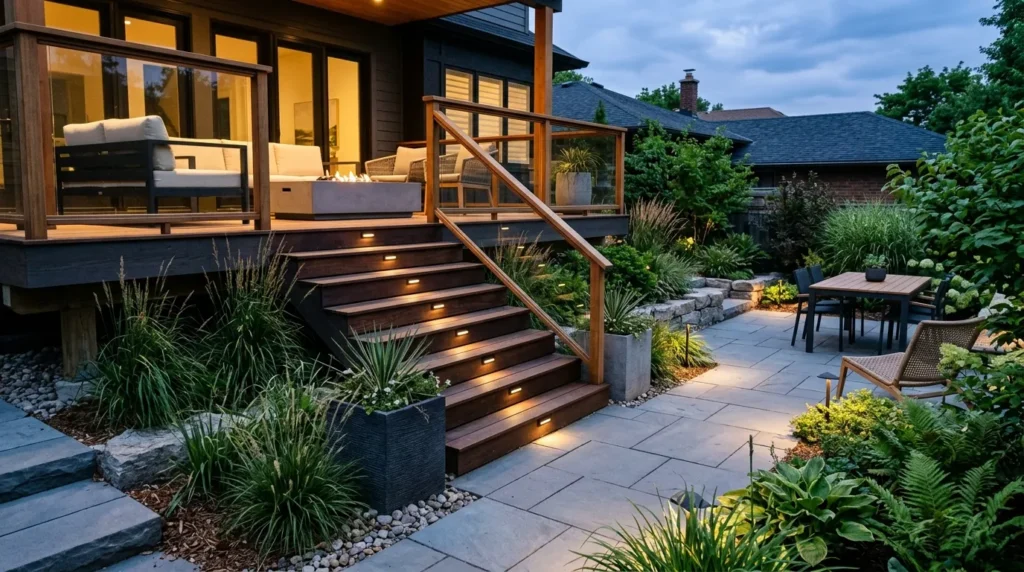
Small step lights can provide enough illumination to make the edges and surfaces easier to identify without creating harsh glare.
This is an area where lighting should be functional first and decorative second. Fixtures should illuminate the walking surface rather than shine directly into people’s eyes.
Step lighting is especially useful around raised decks, retaining walls, outdoor kitchens, sunken patios, and garden stairs.
How To Style It
For a clean contemporary appearance, use small recessed or low-profile fixtures where appropriate for the structure.
For traditional landscapes, compact lantern-style fixtures can provide both illumination and decorative character.
Keep the lighting consistent across a staircase. Uneven brightness can make steps harder to interpret visually.
Extend subtle lighting to the nearby pathway so the transition from one area to another feels natural.
7. Garden Accent Lights
Quick Benefits
- Highlights plants after sunset
- Adds landscape depth
- Creates focal points
- Makes flower beds visible at night
- Works with existing landscaping
Why It Works
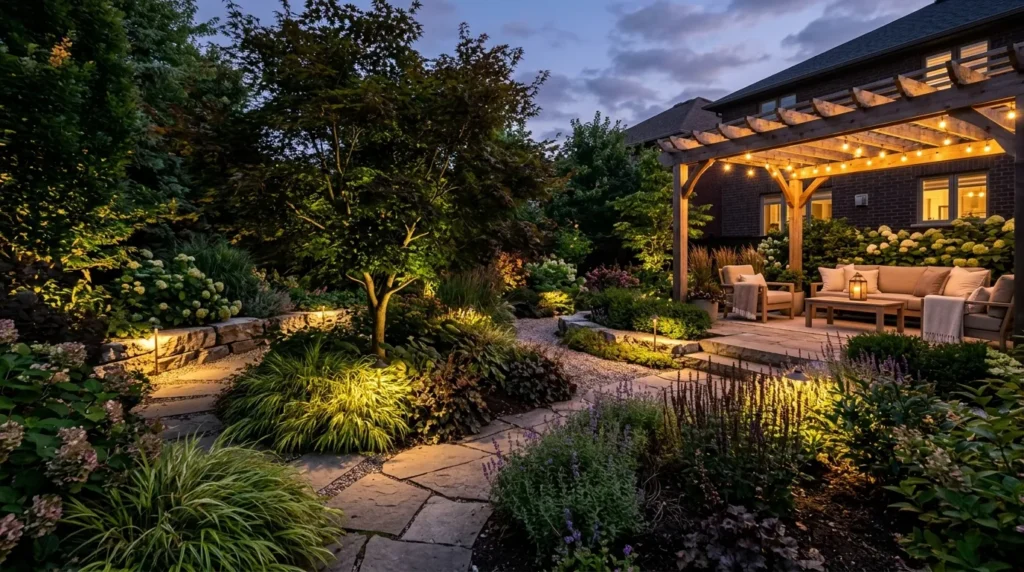
A backyard shouldn’t disappear after dark. Accent lighting allows you to continue enjoying trees, shrubs, flowers, stonework, and garden structures during the evening.
Instead of lighting every plant, select a few features that deserve attention. A sculptural shrub, ornamental tree, flowering bed, fountain, or textured stone wall can become a focal point when softly illuminated.
This technique also creates layers. A patio may be the main gathering area, but illuminated planting farther away gives the eye something to explore.
I’ve noticed that gardens often look more dimensional at night when the lighting isn’t uniform. Darker areas between illuminated features create contrast and depth.
How To Style It
Walk through your garden during daylight and identify the elements you naturally notice first. These are good candidates for accent lighting.
Use different fixture positions to experiment with shadows. Light from below for vertical plants, from the side for textured surfaces, and from a distance when you want a broader wash.
Keep the intensity moderate. The goal is to reveal the landscape, not make every plant look like a spotlight display.
8. Wall Sconces
Quick Benefits
- Adds useful exterior lighting
- Complements architecture
- Works near doors and patios
- Provides a polished appearance
- Can improve entry visibility
Why It Works
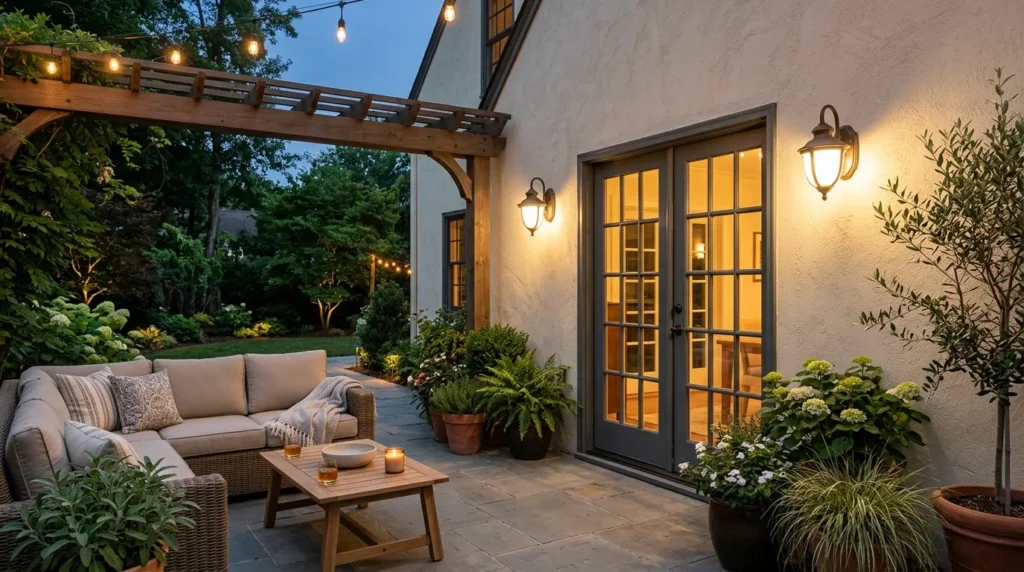
Exterior wall sconces are especially useful when the backyard connects directly to the house.
They can illuminate patio doors, outdoor kitchens, covered porches, garages, and entertaining areas while reinforcing the architectural style of the home.
Unlike temporary lighting, properly installed exterior fixtures can become part of the house itself.
Placement matters considerably. Fixtures should provide useful illumination without producing uncomfortable glare or shining directly toward neighboring properties.
How To Style It
Match the fixture finish with existing exterior hardware when possible. Repeating black, bronze, brass, or another finish creates visual consistency.
Use matching fixtures on either side of a door for a balanced traditional look.
For a modern home, a pair of simple vertical sconces can emphasize clean architectural lines.
Near a patio, combine wall sconces with lower landscape lighting so the light doesn’t all come from one height.
9. Poolside Glow
Quick Benefits
- Creates a relaxing evening atmosphere
- Highlights pool landscaping
- Improves visibility around gathering areas
- Defines outdoor seating
- Adds resort-inspired character
Why It Works
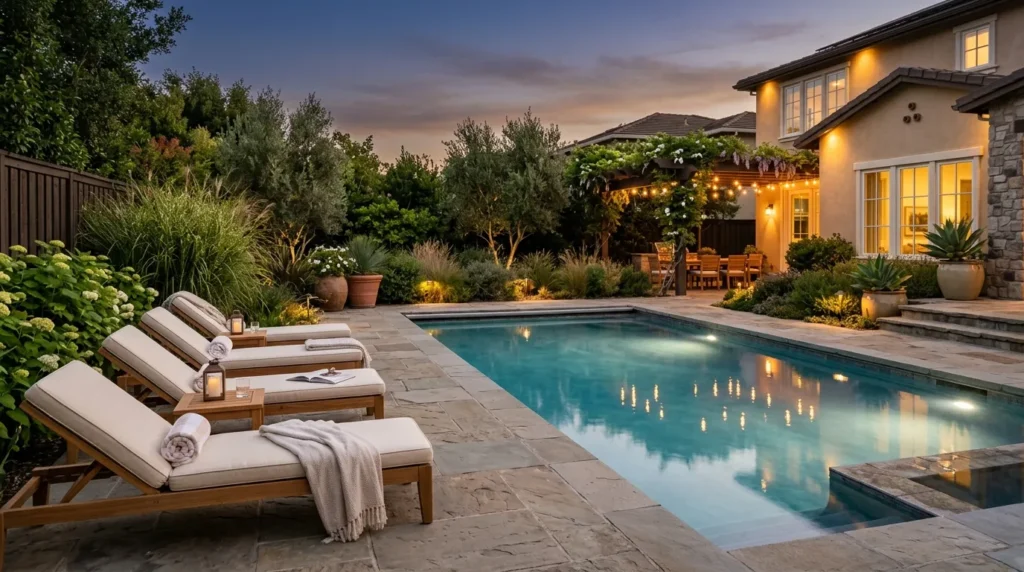
Pool areas often become the center of outdoor entertaining after sunset, but lighting needs to be planned carefully because water, electricity, and wet surfaces create additional safety considerations.
Rather than relying only on bright pool lighting, consider the entire surrounding environment. Pathways, nearby trees, seating areas, steps, and landscaping can all contribute to the nighttime atmosphere.
Soft lighting around the perimeter can make the pool feel integrated into the landscape instead of appearing as an isolated bright rectangle.
Any lighting installed in or near a pool should be appropriate for that application and installed according to applicable safety requirements.
How To Style It
Keep the brightest functional lighting focused where it’s actually needed.
Use low-level landscape lights around nearby planting and paths. Lanterns can add warmth around seating areas where suitable.
Large planters, palms where climate permits, ornamental grasses, and comfortable lounge furniture can reinforce a resort-like appearance.
Avoid excessive decorative lighting directly around the water. The reflections and surrounding landscape can provide plenty of visual interest on their own.
10. Layered Landscape Lighting
Quick Benefits
- Creates balanced illumination
- Combines practical and decorative lighting
- Makes the yard feel larger
- Highlights multiple features
- Allows flexible evening use
Why It Works
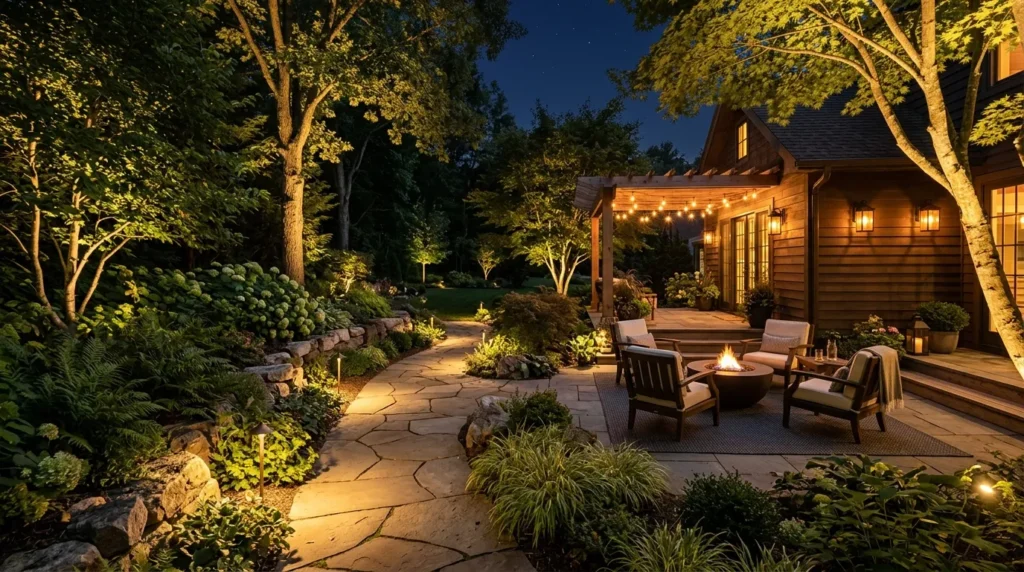
Layered lighting is often the difference between a backyard that is simply illuminated and one that feels intentionally designed.
Instead of relying on one type of fixture, combine several levels of light.
Pathway lights handle navigation. Accent lights highlight landscaping. String lights define seating areas. Wall fixtures illuminate entrances. Step lights address changes in elevation.
The result is a backyard with depth and contrast.
You don’t need to install everything at once. Start with the areas you use most and gradually build the lighting scheme.
One of the biggest advantages of layering is flexibility. Different lighting zones can be controlled independently, allowing you to use only what you need at a particular time.
How To Style It
Think about the backyard in three levels: low, middle, and high.
Low lighting includes pathway fixtures, lanterns, and step lights. Middle-level lighting can come from wall sconces, planters, and small garden fixtures. Higher lighting includes string lights, pergola fixtures, and carefully positioned tree illumination.
Try to distribute the light rather than concentrating it in one area.
Leave some spaces darker. Those quieter areas create contrast and make the illuminated features feel more dramatic.
How To Plan Outdoor Lighting
Before purchasing fixtures, spend some time observing your backyard after dark.
Walk through the space and identify where you have difficulty seeing steps, paths, or changes in elevation. Then look for features that disappear at night but would add visual interest if illuminated.
Think about how the space is used.
A backyard designed primarily for outdoor dining needs different lighting from one used for gardening or poolside entertaining.
It’s also helpful to sketch a simple layout. Mark the patio, pathways, trees, steps, doors, garden beds, and other important features.
Then assign lighting priorities.
First: safety and navigation.
Second: functional areas such as dining and cooking.
Third: decorative features such as trees and planting.
This prevents you from spending most of your budget on decorative lighting while leaving practical areas poorly illuminated.
Warm Or Cool Outdoor Lighting?
For residential outdoor spaces, warmer light is often preferred for patios, entertaining areas, and landscape features because it creates a comfortable evening atmosphere.
Cooler light can provide a crisper appearance and may be appropriate for certain architectural or security applications.
The best choice depends on the fixture, surrounding materials, landscape colors, and personal preference.
Try to keep the color temperature relatively consistent within connected areas. Mixing dramatically different light colors can make the landscape feel disjointed.
Solar, Battery, Or Wired Lighting?
Each option has advantages.
Solar Lighting
Solar fixtures can be convenient because they don’t require conventional electrical wiring. Their performance depends on sunlight, battery capacity, weather, and product quality.
Battery Lighting
Battery-powered fixtures are flexible and useful for lanterns, temporary installations, and areas where wiring isn’t practical. Batteries require periodic replacement or charging.
Wired Lighting
Wired systems can provide reliable, consistent illumination but require appropriate installation. Permanent electrical work should comply with local requirements and be performed by a qualified professional when necessary.
For many backyards, a combination works well. Use permanent lighting where reliability matters and portable fixtures where flexibility is more useful.
How To Make Outdoor Lighting Look Expensive
You don’t need dozens of fixtures to create a sophisticated backyard.
Hide the light source when possible.
The effect should be visible more than the fixture itself.
Use repetition.
Repeating the same fixture style along a pathway or garden border creates consistency.
Create contrast.
Not every corner needs illumination. Darker areas make focal points more noticeable.
Light textures.
Stone walls, tree bark, wood fencing, and layered foliage can become beautiful features when illuminated from the side.
Avoid excessive brightness.
A comfortable backyard usually benefits more from controlled layers than from maximum output.
Common Outdoor Lighting Mistakes
One common mistake is installing too many lights at once.
Another is placing fixtures where the light shines directly into people’s eyes or neighboring windows.
Inconsistent spacing can make pathways look unfinished, while excessive symmetry may make natural gardens feel overly formal.
Homeowners also sometimes forget to consider maintenance. Fixtures exposed to weather may require cleaning, repositioning, or replacement over time.
Finally, don’t ignore the surrounding landscape. Lighting should complement plants, architecture, furniture, and pathways rather than compete with them.
FAQ
What is the best type of outdoor lighting for a backyard?
There isn’t one best fixture for every backyard. A combination usually works better. Path lights can improve navigation, string lights can create a comfortable entertaining area, and accent lights can highlight trees and landscaping. The ideal combination depends on how the yard is used, the home’s architecture, and the features you want to emphasize.
What color light is best for outdoor lighting?
Warm white lighting is commonly chosen for residential patios, gardens, and entertaining areas because it creates a softer, comfortable atmosphere. However, the appropriate color depends on the fixture and application. Consistency is important, so try to avoid mixing dramatically different light colors within the same visual area.
How can I make my backyard look good at night?
Use layered lighting rather than illuminating everything equally. Combine pathway lights, tree uplighting, patio lighting, wall fixtures, and garden accents. Leave some areas darker so the illuminated features stand out. This creates depth and makes the backyard feel more intentional.
Are solar outdoor lights worth it?
Solar lights can be useful for pathways, garden accents, and areas where electrical wiring isn’t practical. Their performance depends on sunlight, battery capacity, weather, and product quality. They are convenient but may not provide the same consistency as a properly installed wired system.
How far apart should pathway lights be?
Spacing depends on the fixture’s brightness, beam spread, pathway width, landscape, and desired appearance. Avoid creating a continuous bright line. Alternating fixtures or using wider spacing can produce a softer and more natural garden effect while still providing useful visibility.
How do I light trees in my backyard?
Uplighting from near the base of a tree can emphasize the trunk and branches. Larger trees may require more than one fixture. Position lights carefully to avoid glare and to highlight the tree’s most attractive structure. Experiment with placement before permanently installing the fixtures.
Is outdoor lighting expensive to install?
The cost varies significantly depending on the number of fixtures, materials, wiring, electrical requirements, and installation complexity. You can begin with simple portable or solar fixtures and expand gradually. Permanent electrical installations may require professional work and should meet applicable local safety requirements.
Conclusion
Good outdoor lighting does more than brighten a backyard. It changes how the space feels and how long you can comfortably enjoy it.
The most successful approach is rarely about making the entire yard bright. Instead, think about where you want people to walk, gather, dine, relax, and look. Then use different types of lighting to support those activities.
String lights can create a cozy ceiling over a patio. Pathway fixtures can quietly guide guests through the garden. Tree uplighting can reveal beautiful branches after sunset, while lanterns add warmth at eye level. For a more polished result, combine several techniques and allow some areas to remain naturally darker.
Start small if you’re unsure. Light the patio first, then add pathway or garden lighting as you see how the space works at night.
With thoughtful placement, consistent finishes, and a balance between function and atmosphere, even a simple backyard can become a beautiful evening retreat that feels inviting long after the sun goes down.
Related Articles
- 12 Backyard Decor Ideas for a Cozy Outdoor Space
- 11 Backyard Landscaping Ideas for Every Home
- 11 Backyard Privacy Ideas for a More Secluded Yard
- 11 Backyard Pool Landscaping Ideas
- 10 Small Patio Ideas for Cozy Outdoor Living