11 Backyard Privacy Ideas for a More Peaceful Outdoor Space
A backyard should feel like a place where you can relax without constantly thinking about neighboring homes, busy streets, or people looking into your outdoor space. But creating privacy doesn’t always mean building a tall fence around the entire property.
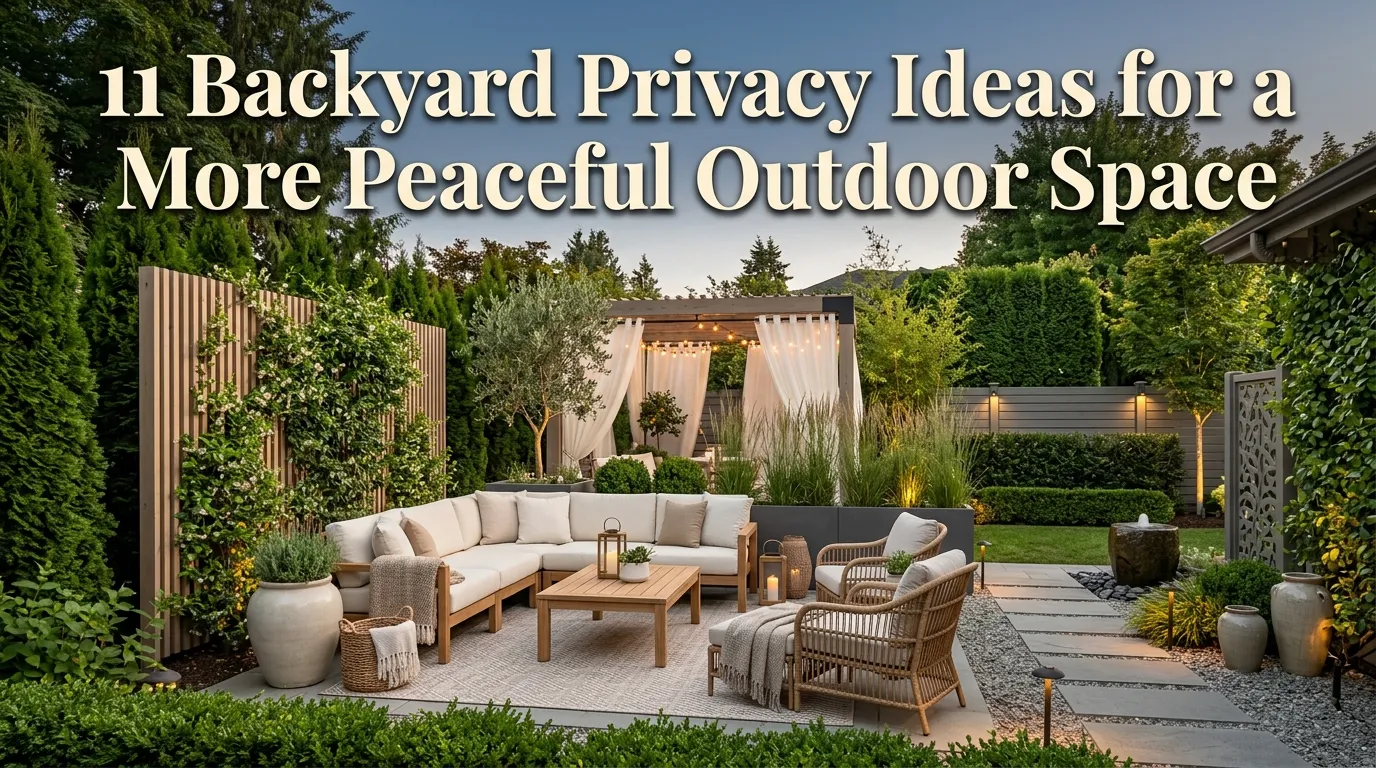
The most inviting private yards usually combine several layers: trees, shrubs, ornamental grasses, fencing, trellises, pergolas, screens, and thoughtfully arranged outdoor furniture. This creates separation while keeping the landscape attractive and connected to nature.
I’ve noticed that privacy works best when it is designed around the way you actually use your backyard. You may only need screening around a patio, pool, dining area, or favorite lounge chair rather than the entire yard. Focusing on those areas can save money, reduce maintenance, and create a more natural result.
Plant selection also matters. A fast-growing tree might seem like an obvious solution, but mature size, roots, maintenance, sunlight, and local growing conditions all need to be considered. The same applies to hedges and screening plants. Something that looks perfectly sized at the garden center can eventually become difficult to manage.
Hardscape features can provide another layer of privacy. A slatted wood screen, pergola, lattice panel, or strategically positioned fence can block specific sightlines without making a yard feel enclosed.
These 11 backyard privacy ideas focus on practical and visually appealing ways to make outdoor spaces feel more secluded. Whether you have a large suburban yard, a compact patio, a pool area, or a small urban backyard, you’ll find ideas that can be adapted to different layouts and budgets.
You don’t need to tackle everything at once. Start by identifying the views you most want to block, then choose a privacy solution that complements your home’s architecture and the landscape around it.
Table of Contents
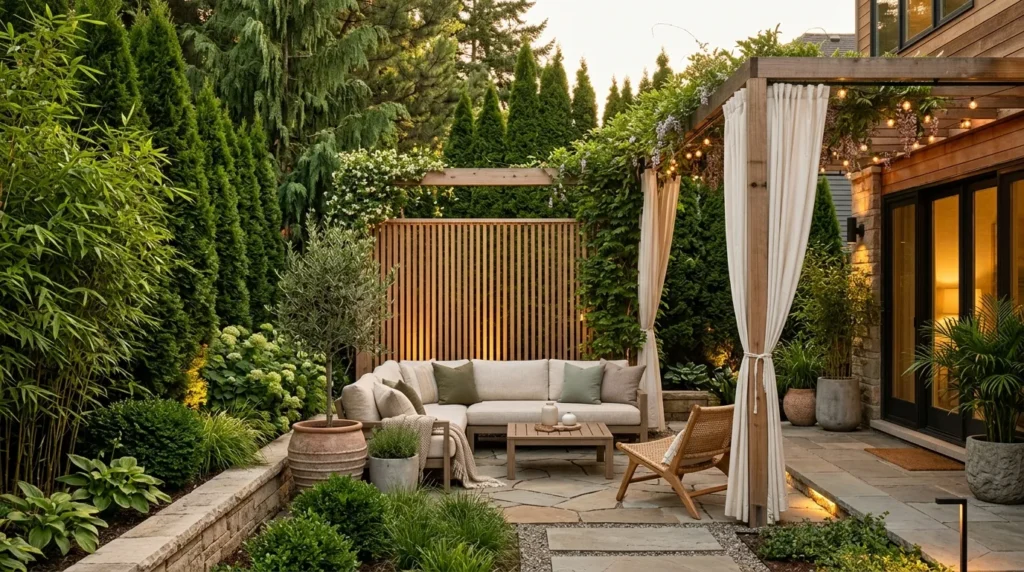
1. Layered Privacy Planting
Combine trees, shrubs, grasses, and ground covers for natural screening.
2. Evergreen Privacy Hedge
Create year-round screening with appropriately selected evergreen plants.
3. Slatted Wood Screens
Use modern wood panels to block specific sightlines while keeping the space open.
4. Tall Ornamental Grasses
Add movement, texture, and seasonal privacy around outdoor living areas.
5. Pergola Privacy
Combine a pergola with screens or climbing plants to create a secluded retreat.
6. Trellis With Vines
Use vertical growing space to create a softer natural privacy barrier.
7. Privacy Fence
Upgrade a traditional fence with landscaping and thoughtful design details.
8. Container Privacy
Use large planters and tall plants when permanent landscaping isn’t practical.
9. Backyard Privacy Trees
Use appropriately sized trees to create height and visual separation.
10. Patio Privacy
Design privacy directly around seating, dining, and entertaining areas.
11. Mixed Privacy Layers
Combine several methods for a more complete and natural-looking solution.
1. Layered Privacy Planting
Quick Benefits
- Creates natural-looking screening
- Adds depth and texture
- Softens property boundaries
- Can provide seasonal interest
- Works with many landscape styles
Why It Works
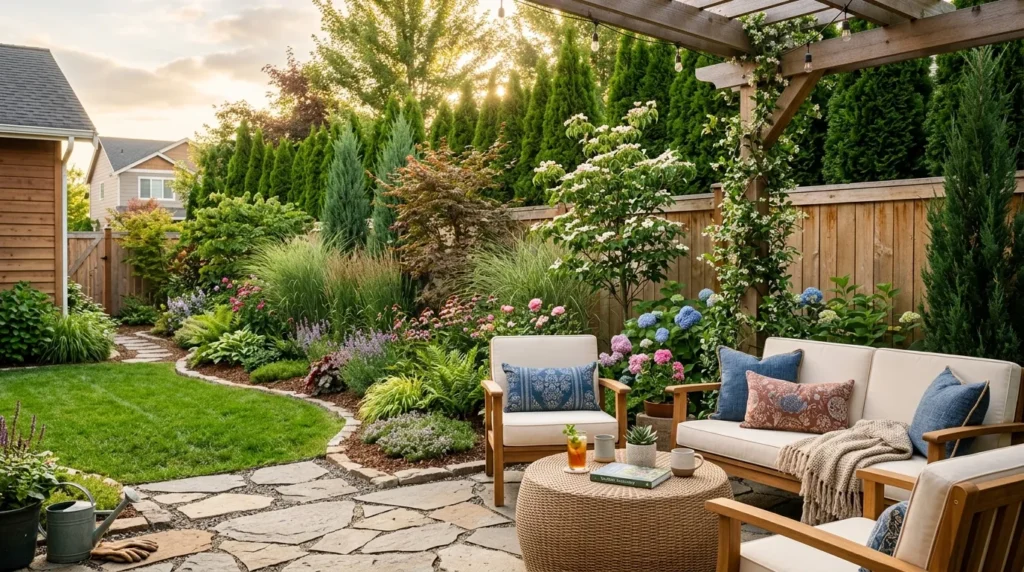
A single row of plants can create privacy, but layered planting often looks much more natural. Instead of creating a solid green wall, you combine different heights and textures to interrupt views.
For example, small trees can provide height, shrubs can fill the middle layer, and ornamental grasses or ground covers can soften the bottom. This approach also makes the privacy feature feel like part of the garden rather than something added purely for screening.
Layered planting can be especially effective when you want privacy without making the yard feel boxed in.
How To Style It
Start with the sightline you’re trying to block. Place taller plants toward the back and progressively shorter plants toward the front.
Try combinations such as:
- Small trees with evergreen shrubs.
- Ornamental grasses in front of shrubs.
- Flowering shrubs mixed with evergreens.
- Tall grasses beneath small trees.
- Ground covers beneath privacy shrubs.
- Native plants arranged at different heights.
- Mixed shrubs along a fence.
- Small trees surrounding a patio.
- Flowering plants beneath evergreen screening.
- Layered greenery around a pool.
Choose plants with compatible sunlight, water, and soil requirements. The best-looking privacy garden is one that can thrive without constant intervention.
2. Evergreen Privacy Hedge
Quick Benefits
- Provides year-round greenery
- Creates a defined boundary
- Can reduce visual distractions
- Works with formal and informal gardens
- Adds structure during winter
Why It Works
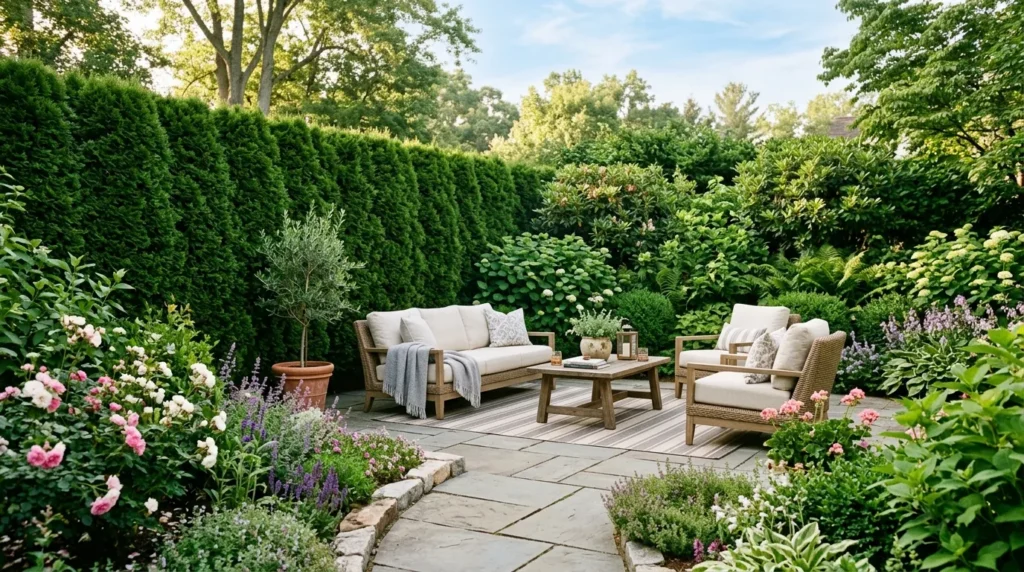
Evergreen hedges are a classic privacy solution because they retain their foliage through much of the year. A well-maintained hedge can create a strong visual boundary without requiring a conventional privacy wall.
The important part is choosing a species that fits the available space. Some evergreen shrubs eventually become extremely wide or tall, which can create maintenance problems.
Before planting, research mature dimensions, growth habits, local climate suitability, and potential pest or disease concerns.
How To Style It
Consider:
- Evergreen hedge behind a patio.
- Mixed evergreen border along a property line.
- Formal clipped hedge around a garden.
- Natural hedge behind outdoor seating.
- Evergreen screening around a pool.
- Layered hedge with flowering shrubs.
- Low hedge combined with taller trees.
- Evergreen screen beside a deck.
- Hedge surrounding an outdoor dining area.
- Evergreen backdrop behind a garden bench.
Leave sufficient access for pruning and maintenance. A hedge should create privacy without becoming difficult to reach.
3. Slatted Wood Screens
Quick Benefits
- Provides targeted privacy
- Adds architectural interest
- Works in modern backyards
- Can divide outdoor zones
- Allows some light and airflow
Why It Works
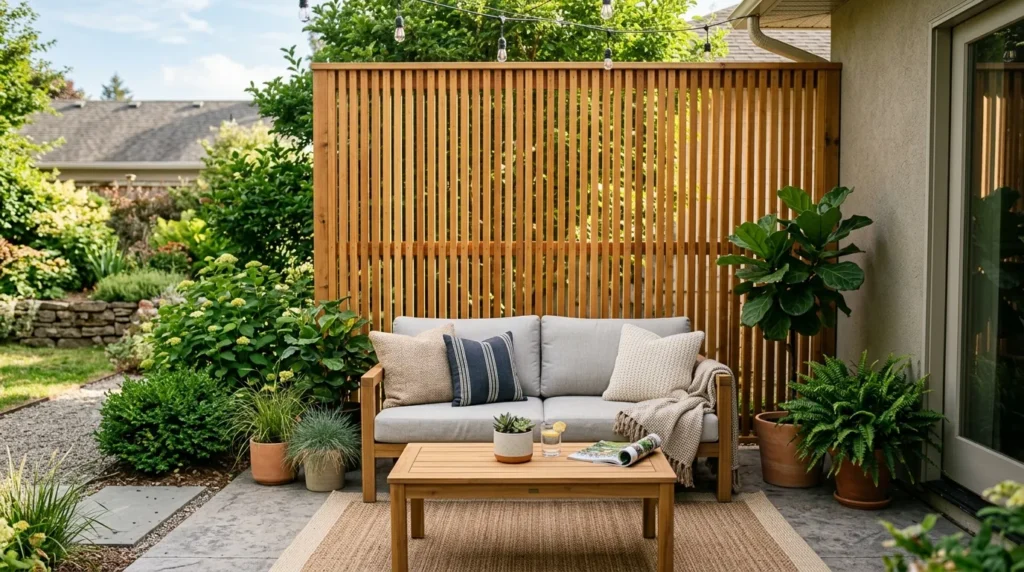
A slatted wood screen can block a specific sightline without completely closing off the yard.
This makes it particularly useful around patios, outdoor kitchens, hot tubs, seating areas, and decks. The gaps between slats allow sunlight and air to pass through while reducing direct visibility.
Wood also brings warmth to spaces dominated by concrete, stone, or metal.
How To Style It
Try:
- Horizontal wood privacy screen.
- Vertical cedar slats behind a patio.
- Wood screen beside an outdoor dining area.
- Slatted divider around a lounge.
- Wood panel behind a built-in bench.
- Screen separating a pool from the rest of the yard.
- Slatted screen around an outdoor shower.
- Wood divider beside a garden.
- Screen behind a fire pit.
- Wood panel combined with climbing plants.
Use an exterior-rated material and finish appropriate for your local climate. Design the screen so it remains stable and doesn’t obstruct required access or drainage.
4. Tall Ornamental Grasses
Quick Benefits
- Add movement
- Create soft visual screening
- Provide texture
- Work well around patios
- Can complement modern landscapes
Why It Works
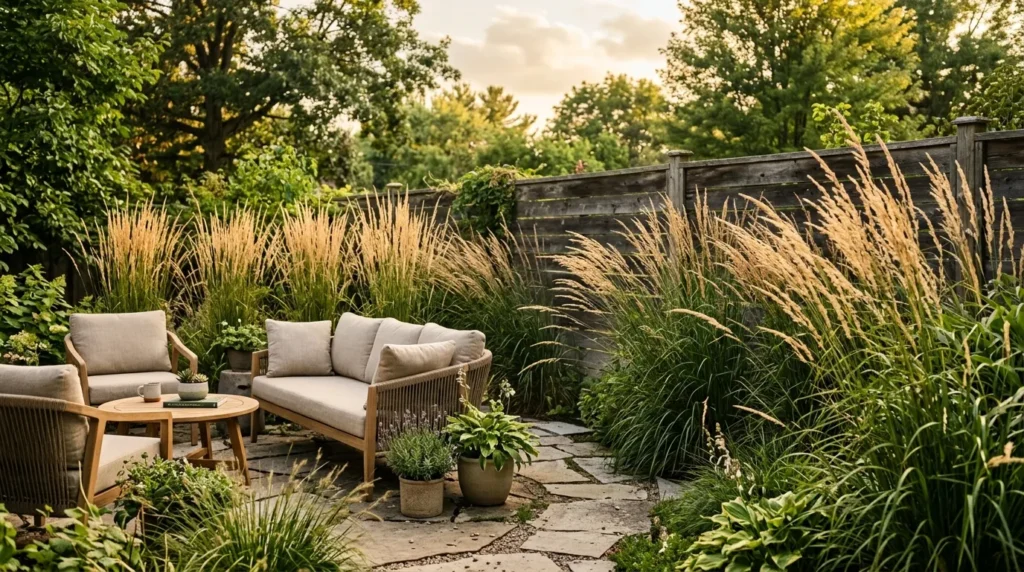
Tall ornamental grasses can create privacy without the heavy appearance of a solid hedge.
Their fine foliage moves with the breeze, making them particularly attractive around seating areas and patios. They can also soften hard fences and walls.
Because different grass varieties have very different growth habits, choose species based on mature height, width, sunlight, and local growing conditions.
How To Style It
Consider:
- Tall grasses along a fence.
- Grass clusters around a patio.
- Grasses behind outdoor loungers.
- Ornamental grasses around a pool.
- Mixed grass border beside a deck.
- Grasses around a fire pit.
- Repeated grass clusters along a pathway.
- Tall grasses surrounding a garden bench.
- Grasses between neighboring properties.
- Layered grasses with evergreen shrubs.
Plant grasses in groups rather than scattering individual plants randomly. Repetition creates a more intentional landscape.
5. Pergola Privacy
Quick Benefits
- Creates a defined outdoor room
- Adds shade potential
- Provides vertical structure
- Works for patios and decks
- Can support climbing plants
Why It Works
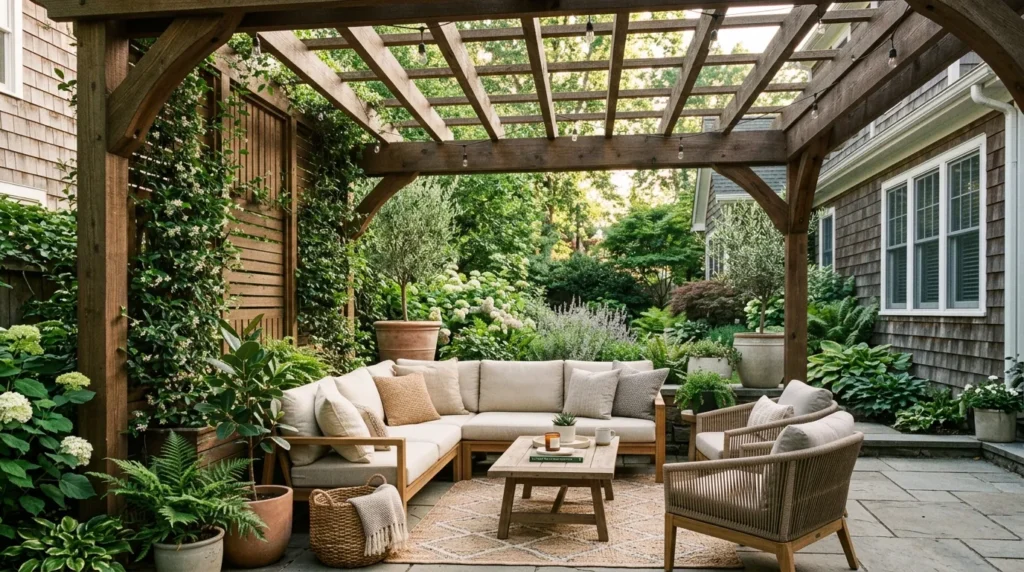
A pergola can transform an exposed seating area into a more private outdoor room. Adding slatted sides, curtains designed for outdoor use, screens, or climbing plants can further reduce visibility.
This approach works especially well when privacy is needed around a specific gathering area rather than the entire property.
How To Style It
Try:
- Wood pergola over a patio.
- Pergola with slatted privacy walls.
- Pergola covered with climbing greenery.
- Outdoor curtains on selected sides.
- Pergola around a dining area.
- Pergola beside a swimming pool.
- Small pergola over a lounge area.
- Pergola with integrated planters.
- Modern metal pergola with greenery.
- Pergola surrounding an outdoor kitchen.
Keep at least one side visually open where possible. This can preserve the feeling of space while still creating a more private destination.
6. Trellis With Vines
Quick Benefits
- Uses vertical space
- Adds flowers and foliage
- Softens fences
- Works in smaller yards
- Creates a garden-like atmosphere
Why It Works
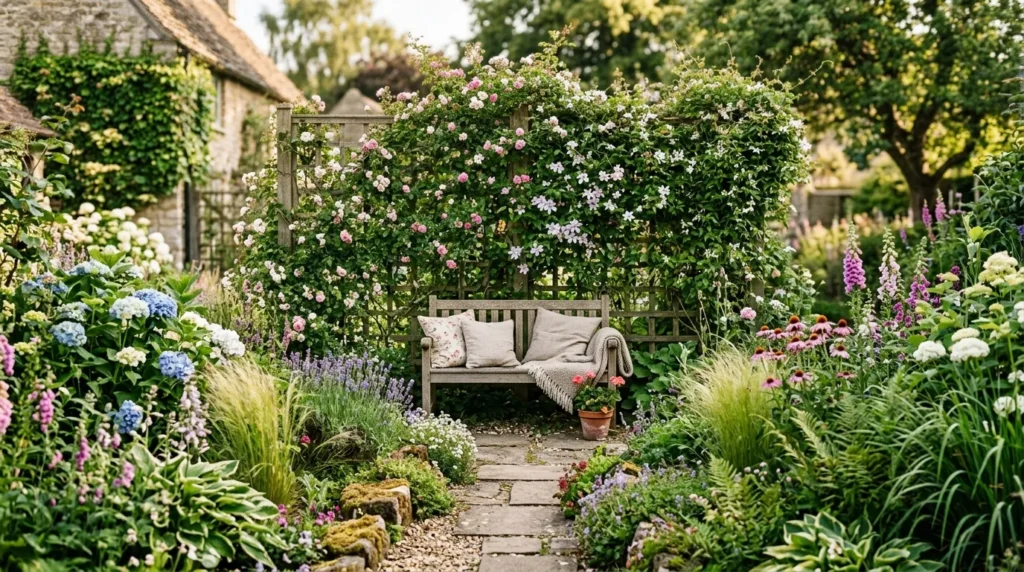
A trellis with suitable climbing plants can create a softer privacy barrier than a solid wall.
It’s especially useful when horizontal space is limited. Instead of planting a wide hedge, you can direct greenery upward.
However, climbing plants vary significantly in growth speed, weight, and attachment method. Some can become invasive or damage structures, so select varieties carefully for your region and support system.
How To Style It
Consider:
- Wooden trellis along a patio.
- Flowering vines beside a deck.
- Climbing greenery along a fence.
- Trellis behind a garden bench.
- Vertical garden screen.
- Trellis around an outdoor dining space.
- Climbing plants around a pergola.
- Narrow vine screen for a small yard.
- Trellis separating garden zones.
- Flowering vine privacy wall.
Install a sturdy support system that can handle the mature weight of the plants you’re growing.
7. Privacy Fence
Quick Benefits
- Provides immediate visual separation
- Defines property boundaries
- Works in many backyard styles
- Creates a backdrop for landscaping
- Can improve the feeling of enclosure
Why It Works
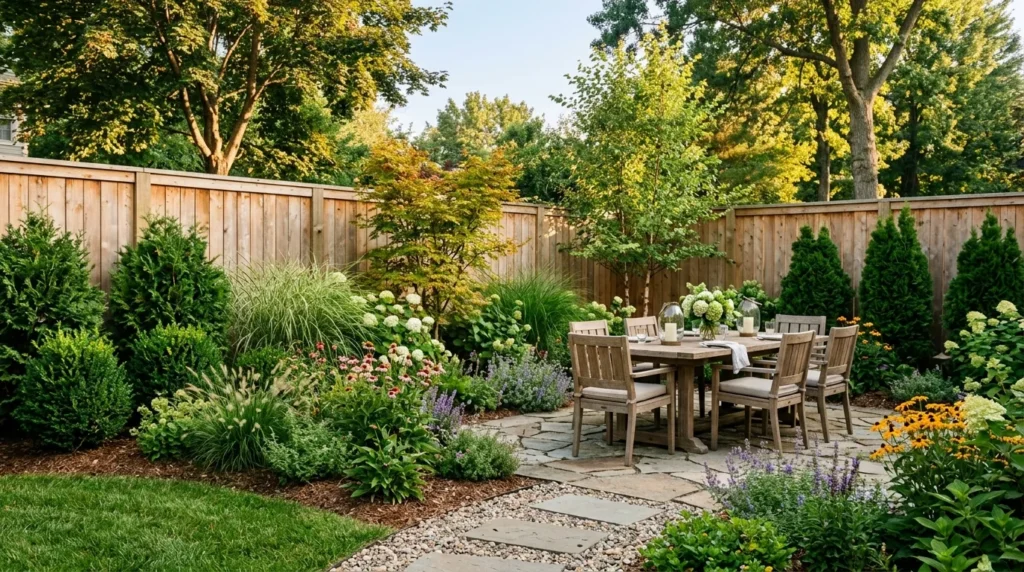
A fence remains one of the most practical ways to create backyard privacy, especially when neighboring properties are close together.
But a fence doesn’t have to be the only design element. Plants can soften it, while changes in material, height, or pattern can give it more visual interest.
Before construction, check local regulations, property boundaries, HOA requirements, and applicable height restrictions.
How To Style It
Try:
- Wood fence softened with shrubs.
- Horizontal privacy fence.
- Vertical board fence.
- Fence with integrated planter boxes.
- Dark fence behind bright greenery.
- Fence with climbing plants.
- Natural wood fence around a patio.
- Fence combined with ornamental grasses.
- Fence with small trees in front.
- Mixed fence and garden border.
Avoid placing large trees directly against a fence without considering their mature size and root growth.
8. Container Privacy
Quick Benefits
- Works for renters
- Easy to rearrange
- Adds flexible greenery
- Useful for patios and decks
- Doesn’t require permanent planting
Why It Works
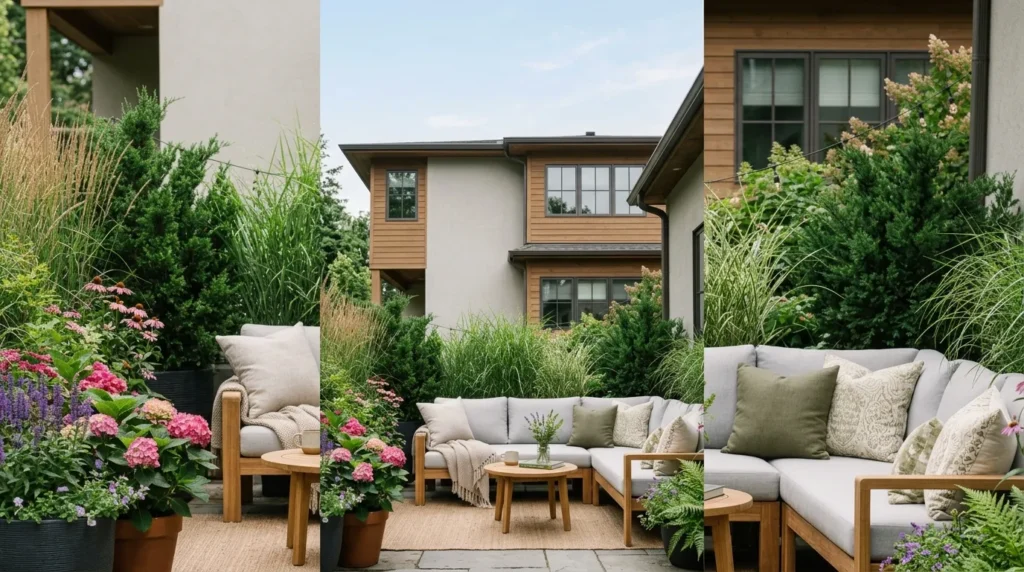
Large containers can create privacy where permanent landscaping isn’t possible. They’re particularly helpful on decks, patios, balconies, rental properties, and compact yards.
Tall plants in oversized planters can interrupt direct sightlines while keeping the rest of the space visually open.
Containers also allow you to change the layout as your needs evolve.
How To Style It
Try:
- Tall planters around a patio.
- Large evergreen containers.
- Ornamental grasses in oversized pots.
- Planters around a deck.
- Matching containers beside a seating area.
- Tall plants around a pool.
- Grouped planters at different heights.
- Container screen along a fence.
- Large planters beside an outdoor kitchen.
- Flowering plants mixed with taller greenery.
Use heavy, stable containers where wind exposure is a concern. Choose plants according to the amount of sunlight the location receives.
9. Backyard Privacy Trees
Quick Benefits
- Add significant vertical interest
- Create shade
- Improve landscape structure
- Can frame views
- Provide long-term screening
Why It Works
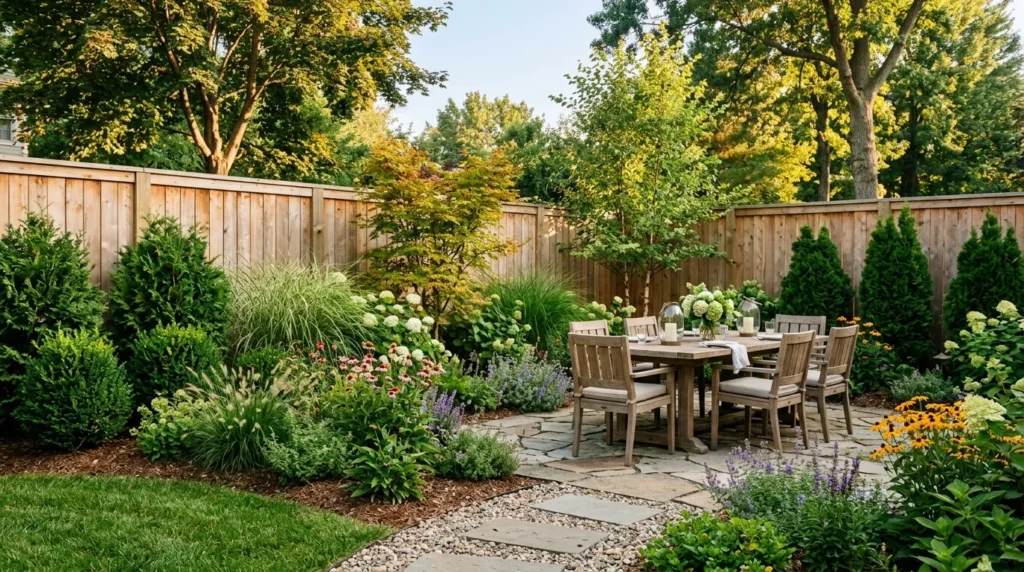
Trees can be one of the most effective ways to create privacy because they introduce height that smaller shrubs cannot easily provide.
The key is patience and planning. A tree may take years to reach its mature size, and the wrong species can eventually create problems with roots, branches, shade, or maintenance.
Rather than choosing the fastest-growing tree available, choose one whose mature characteristics fit your property.
How To Style It
Consider:
- Small trees around a patio.
- Evergreen trees along a boundary.
- Ornamental trees beside a deck.
- Trees framing a backyard view.
- Small trees behind a pool.
- Multi-stem trees near outdoor seating.
- Trees combined with shrubs.
- Flowering trees beside a garden.
- Trees screening a neighboring structure.
- Trees surrounding an outdoor dining zone.
Think about the mature canopy size and root system before planting. Keep trees appropriately separated from buildings, utilities, pools, and other structures.
10. Patio Privacy
Quick Benefits
- Focuses privacy where it matters
- Makes seating more comfortable
- Defines an outdoor room
- Supports entertaining
- Can be achieved without screening the entire yard
Why It Works
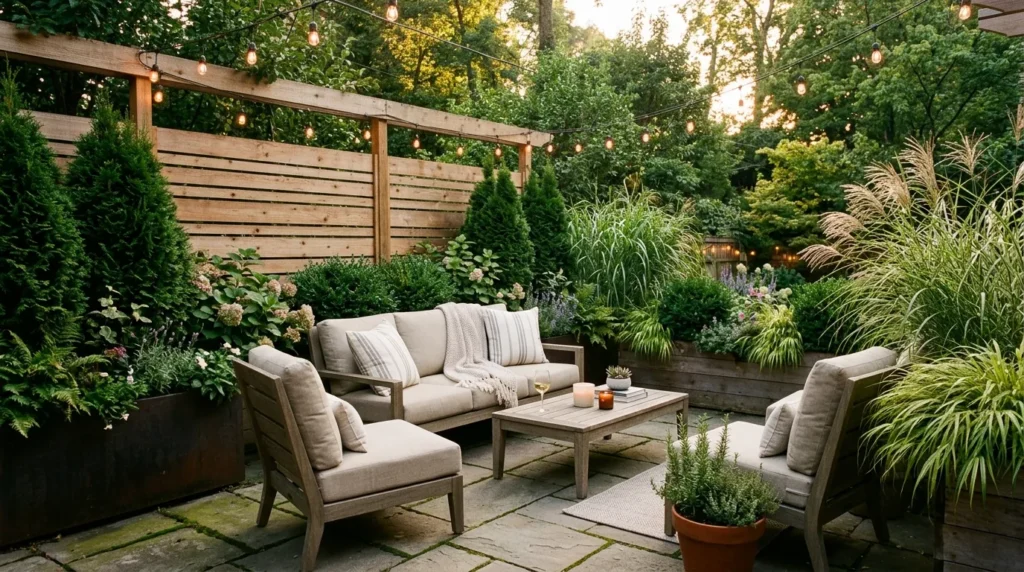
You don’t necessarily need a private backyard—you may simply need a private place within the backyard.
A patio can become a comfortable retreat with a combination of screening plants, furniture placement, fencing, pergolas, and strategically positioned containers.
This is often one of the most practical approaches because you concentrate your investment on the area you use most.
How To Style It
Try:
- Outdoor sofa behind tall planters.
- Patio bordered by evergreen shrubs.
- Privacy screen behind dining furniture.
- Pergola over a lounge area.
- Tall grasses around seating.
- Built-in bench beside a privacy wall.
- Small trees framing a patio.
- Trellis behind outdoor furniture.
- Outdoor curtains on a covered patio.
- Layered planting around the patio perimeter.
Arrange furniture so that seating faces toward the view you want to enjoy rather than toward neighboring properties.
11. Mixed Privacy Layers
Quick Benefits
- Creates stronger visual screening
- Looks more natural
- Allows flexible design
- Combines hardscape and planting
- Works for large and small yards
Why It Works
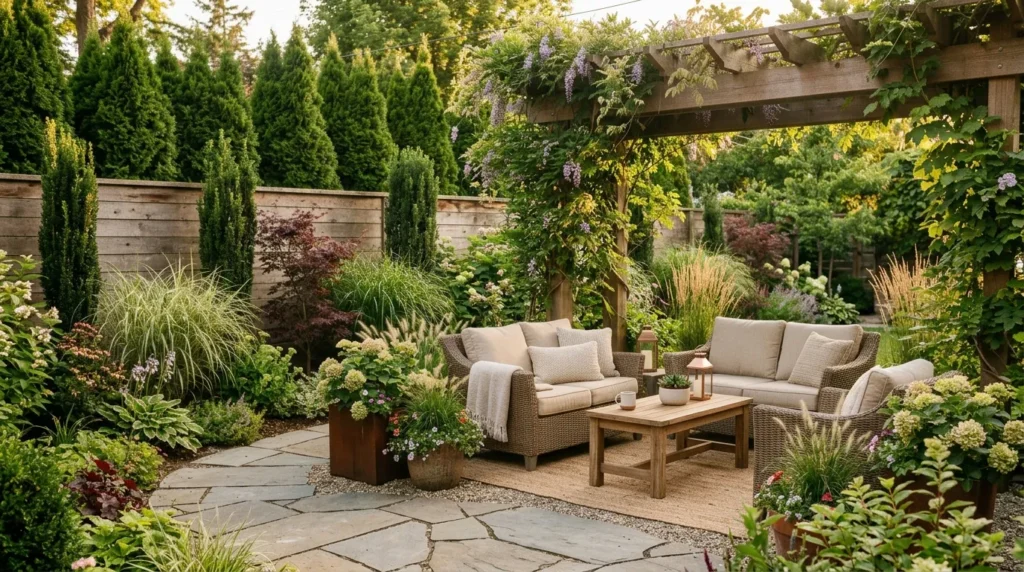
The most convincing privacy designs often use multiple layers rather than one single solution.
For example, a fence can provide the base layer, shrubs can soften it, ornamental grasses can add movement, and a small tree can provide height. Each element performs a different job.
This approach also means that if one plant loses leaves during winter, another layer may still provide visual separation.
How To Style It
Combine:
- Fence plus evergreen shrubs.
- Trees plus ornamental grasses.
- Trellis plus climbing vines.
- Wood screen plus container plants.
- Pergola plus outdoor curtains.
- Fence plus flowering shrubs.
- Small trees plus layered planting.
- Hedge plus patio screen.
- Grasses plus large planters.
- Privacy wall plus vertical garden.
The most important step is identifying your sightlines first. Walk through the yard and note exactly where neighboring windows, roads, or other distractions are visible.
Frequently Asked Questions
What is the cheapest way to create backyard privacy?
Start with targeted screening instead of trying to enclose the entire yard. Affordable options can include appropriately selected plants, simple trellises, ornamental grasses, or strategically placed containers. If you need fencing, compare materials and focus the most substantial privacy treatment on the areas where it is actually needed.
What grows fastest for backyard privacy?
Growth speed varies considerably by plant species and climate. Fast growth isn’t always the best choice because rapidly growing plants can require frequent pruning or eventually become too large for the available space. Choose a species based on mature size, local suitability, maintenance requirements, and the type of screening you need.
How can I make my backyard private without a fence?
Use layered planting, evergreen shrubs, ornamental grasses, small trees, trellises, climbing plants, pergolas, or privacy screens. Large containers can also work for patios and decks. Combining two or three of these approaches can provide privacy while maintaining a softer garden appearance.
What is the best tree for backyard privacy?
There isn’t one best privacy tree for every backyard. Climate, available space, soil, sunlight, mature height, canopy width, and maintenance requirements all matter. Evergreen trees can provide year-round screening, while deciduous trees may offer seasonal shade and visual interest.
How do I create privacy in a small backyard?
Use vertical space. Trellises, climbing plants, narrow screens, tall planters, ornamental grasses, and appropriately sized trees can create privacy without consuming much floor space. Keep the center of the yard relatively open and concentrate screening around the areas where you sit or entertain.
How tall should a backyard privacy screen be?
The appropriate height depends on what you’re trying to block and local regulations. Measure the sightline from the area where you want privacy to the neighboring window, deck, or property. Also check local fence and structure requirements before installing a permanent screen.
How can I make a privacy fence look more attractive?
Soften the fence with plants, vary the planting heights, add a trellis, use integrated planters, or choose a finish that complements your home. A fence surrounded by shrubs and ornamental grasses usually feels more like part of the landscape than a standalone wall.
Conclusion
Creating a private backyard doesn’t mean turning the entire property into a closed-off space. In many cases, the most successful approach is selective privacy—screening the patio, pool, dining area, or favorite seating spot while keeping other parts of the yard open.
Start by identifying the views that bother you most. Once you know exactly what needs to be blocked, choose the simplest solution that fits your landscape. A row of shrubs may be enough in one location, while another may benefit from a combination of fencing, trees, and ornamental grasses.
Think vertically when space is limited. Trellises, pergolas, screens, tall containers, and carefully selected trees can add privacy without taking over the ground.
And don’t overlook aesthetics. Privacy features should feel like part of the garden rather than an afterthought. Repeating materials and plants, softening hard boundaries with greenery, and creating comfortable outdoor zones can make the entire backyard feel more intentional.
Choose one area to improve first. A little screening around a patio or seating area can make a surprisingly big difference in how comfortable your backyard feels.
Related Articles
- 11 Backyard Landscaping Ideas for a Beautiful Outdoor Space
- 12 Backyard Decor Ideas for Cozy Outdoor Living
- 11 Backyard Pool Landscaping Ideas for a Private Retreat
- 15 Small Backyard Ideas for Stylish Outdoor Living
- 17 Patio Landscaping Ideas to Transform Your Yard