

11 Space-Saving Dorm Room Ideas
Dorm rooms are rarely generous with space. A bed, desk, dresser, closet, and a few personal belongings can quickly make a small room feel crowded, especially when you are sharing the space with a roommate.
The good news is that you do not need a large room to create a comfortable and organized dorm. The biggest difference often comes from using the space you already have more intentionally. Empty wall areas, the space beneath the bed, the back of a door, and even the sides of furniture can become useful storage zones.
The most effective dorm organization also combines storage with everyday convenience. A container that looks great but requires you to unpack half your room to reach something probably will not stay organized for long. The best solutions keep frequently used items accessible while giving less-used belongings a designated home.
I’ve noticed that small rooms tend to work better when every storage decision starts with a question: What can go vertical, underneath, behind, or inside something else? This simple approach helps reduce the amount of floor space consumed by storage.
You also do not have to sacrifice personality. Baskets, fabric bins, desk organizers, removable hooks, soft lighting, and coordinated bedding can make a practical dorm feel much more like home.
Whether you are moving into a college dorm for the first time or trying to make an existing room work better, these ideas focus on realistic solutions for students. They can be adapted to shared rooms, narrow layouts, limited closets, and dorms with strict rules about permanent modifications.
Before buying anything, check your school’s housing guidelines and measure the available spaces. Dorm furniture and storage rules vary, and a solution that works beautifully in one room may not fit another.
Table of Contents
1. Under-Bed Storage
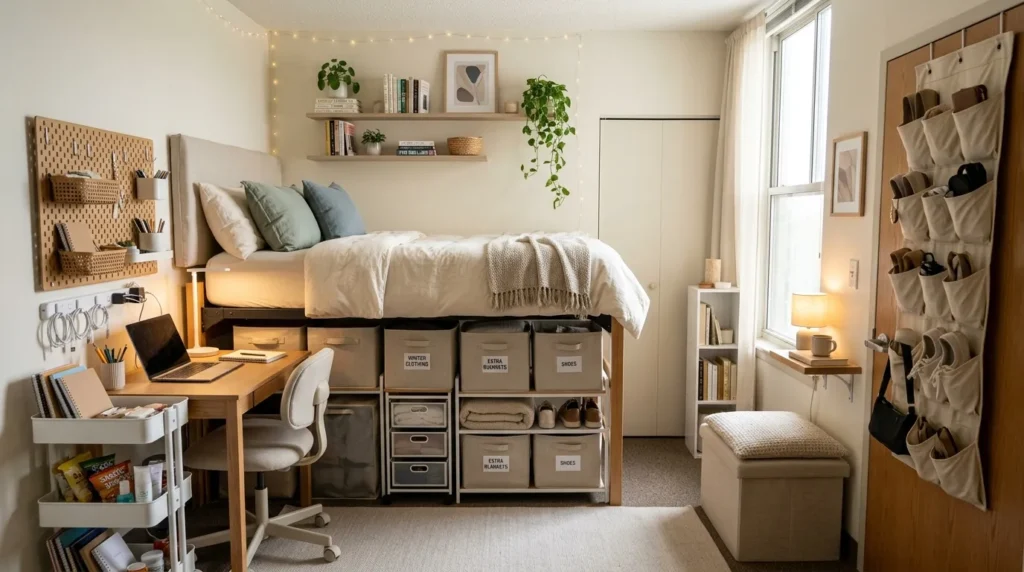
Use the large, often overlooked space beneath the bed for clothing, shoes, linens, and seasonal belongings.
2. Vertical Wall Storage
Take advantage of wall height to organize everyday items without using valuable floor space.
3. Over-Door Organizers
Turn the back of the door into a convenient storage area for smaller essentials.
4. Lofted Bed Space
Use the area beneath a lofted bed as a compact study, storage, or relaxation zone.
5. Rolling Storage Carts
Add narrow mobile storage that can fit beside desks, beds, or other tight spaces.
6. Desk Organization
Keep school supplies accessible while preserving valuable workspace.
7. Hanging Closet Solutions
Maximize limited closet capacity with vertical organizers and coordinated storage.
8. Multiuse Furniture
Choose pieces that serve more than one purpose when dorm rules and space allow.
9. Foldable Storage
Use collapsible solutions that can disappear when they are not needed.
10. Bedside Caddies
Create accessible bedside storage without adding another table or cabinet.
11. Roommate Zone Planning
Divide shared storage and living areas intentionally to keep the room easier to manage.
1. Under-Bed Storage
Quick Benefits
- Uses otherwise wasted space
- Keeps belongings out of sight
- Ideal for seasonal items
- Helps free closet space
- Works in many dorm layouts
Why It Works
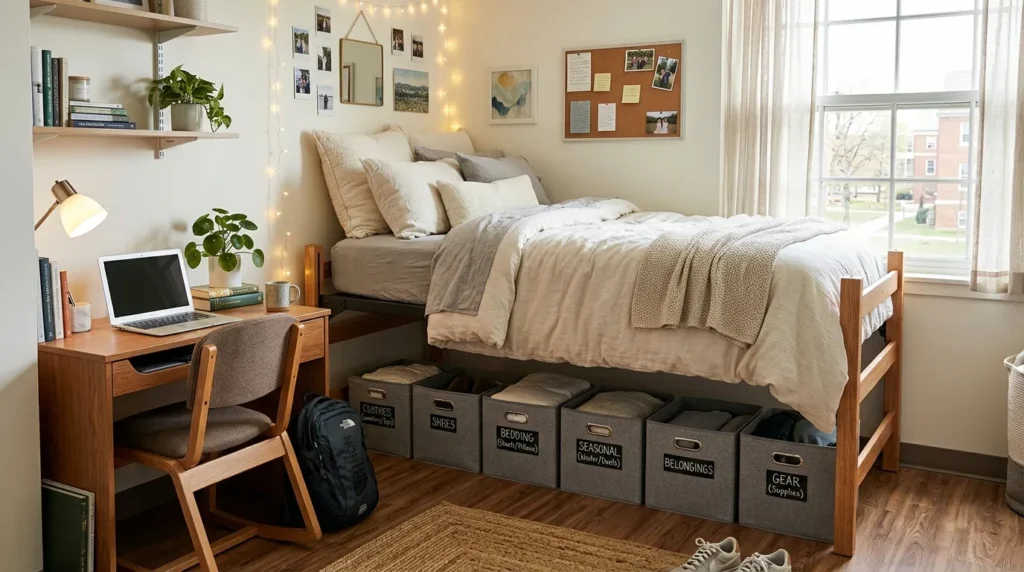
The area underneath a dorm bed can provide a surprising amount of storage, particularly when the bed is raised enough to accommodate containers.
Instead of leaving loose bags and boxes underneath, use a consistent storage system. Low-profile bins, zippered fabric containers, or rolling boxes can keep belongings protected and easier to retrieve.
This area is particularly useful for things you do not need every day, such as extra bedding, winter clothing, luggage, rarely used shoes, or decorations.
The important thing is accessibility. If you put your most frequently used belongings at the very back, you may eventually stop putting things away because retrieving them becomes inconvenient.
How To Style It
Measure the height, width, and depth underneath your bed before purchasing containers.
Use shallow bins that slide out easily. Label each container according to its contents, such as “winter clothes,” “extra bedding,” or “shoes.”
Place frequently used items toward the front and seasonal items farther back.
If your dorm bed has open space underneath, matching fabric bins can make the area look more organized.
Avoid overloading containers to the point that they become difficult to move.
2. Vertical Wall Storage
Quick Benefits
- Saves valuable floor space
- Makes small rooms more functional
- Keeps everyday items visible
- Uses unused wall height
- Can add decorative personality
Why It Works
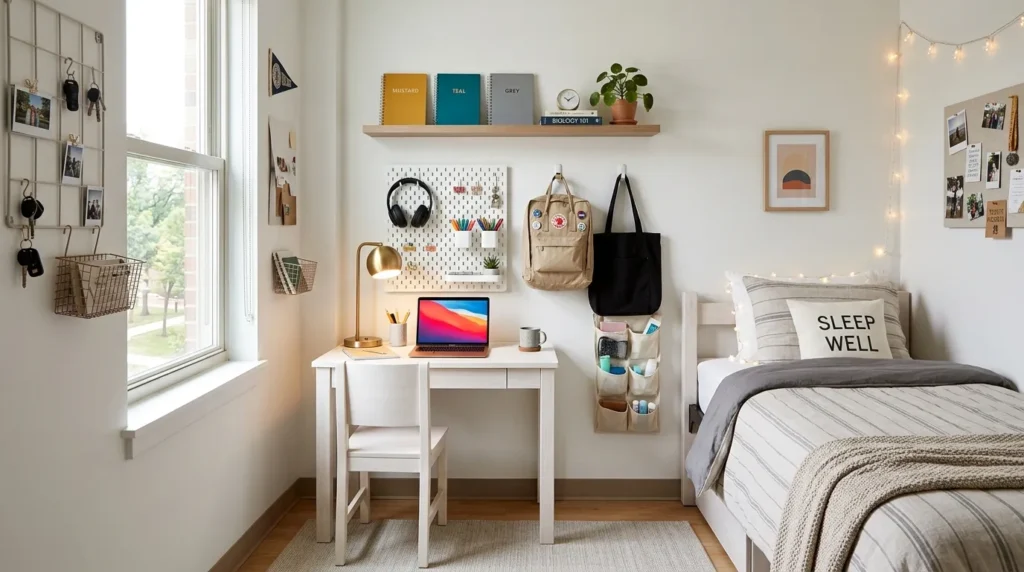
When floor space is limited, look upward. Vertical organization allows you to store and display belongings without adding another piece of furniture.
Depending on your dorm’s rules, options can include removable hooks, adhesive organizers, tension systems, pegboards, or freestanding shelving.
Vertical storage is particularly useful near desks and closets, where students often need quick access to school supplies, headphones, bags, or accessories.
Always check housing rules before attaching anything to walls. Some dorms restrict nails, screws, adhesive products, or other modifications.
How To Style It
Use removable hooks for lightweight bags, hats, headphones, or small accessories where permitted.
A compact wall organizer can hold notebooks, stationery, charging cables, and other study essentials.
Keep frequently used items between eye and shoulder height.
Place less frequently used belongings higher up.
For a cleaner appearance, use matching containers or a consistent color palette rather than filling the wall with unrelated storage products.
3. Over-Door Organizers
Quick Benefits
- Uses unused door space
- Requires little or no floor area
- Good for small accessories
- Easy to access
- Useful in bedrooms and bathrooms
Why It Works
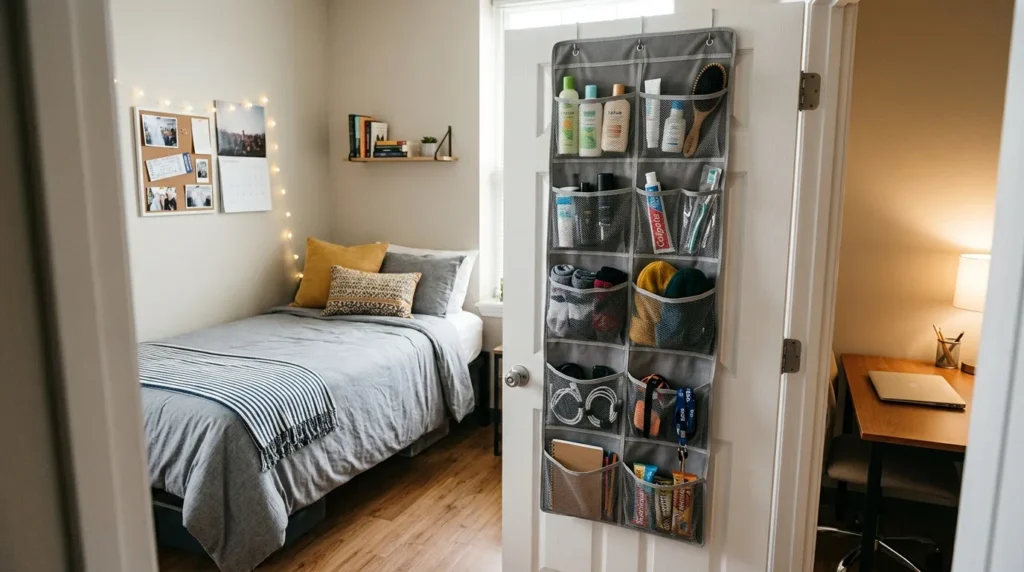
The back of a door is often completely unused, even though it provides a large vertical surface.
An over-door organizer can create pockets for toiletries, cleaning supplies, accessories, snacks, school supplies, or small clothing items.
This is particularly useful when closet and dresser storage are limited.
The main consideration is clearance. Make sure the organizer does not prevent the door from closing properly or interfere with nearby furniture.
How To Style It
Choose an organizer based on what you actually need to store.
Use smaller pockets for chargers, hair accessories, and toiletries.
Larger compartments can hold folded clothing, towels, or bags.
If the organizer is visible from the room, choose a neutral fabric or color that blends with the dorm.
Avoid placing heavy items high on a door if they make the door difficult to open or close.
4. Lofted Bed Space
Quick Benefits
- Creates a second functional zone
- Maximizes vertical space
- Can provide room for a desk
- Opens up floor area
- Makes compact layouts more flexible
Why It Works
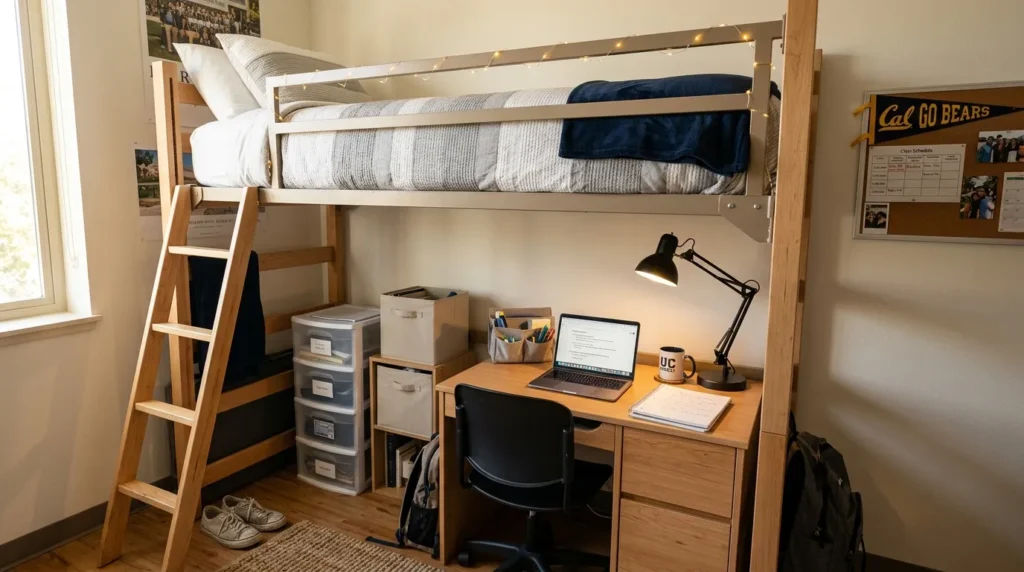
If your dorm provides loftable furniture or allows an approved loft configuration, raising the bed can dramatically change how the room functions.
The area underneath can become a study zone, wardrobe area, reading corner, or additional storage.
This is essentially creating a second layer of usable space in a room where floor area is limited.
However, lofted beds require careful attention to safety, stability, and housing rules. Only use configurations and equipment approved by your school.
How To Style It
For a study area, place the desk directly beneath the lofted bed if the furniture is designed for that arrangement.
Add a compact desk lamp, organizer, and comfortable chair.
If the area is used for relaxation, add a small chair, floor cushion, and warm lighting where permitted.
Keep the area underneath uncluttered so it does not become a collection of random boxes.
Use one storage system rather than several unrelated pieces.
5. Rolling Storage Carts
Quick Benefits
- Fits narrow spaces
- Easy to move
- Provides multiple storage levels
- Useful beside desks
- Can serve different purposes
Why It Works
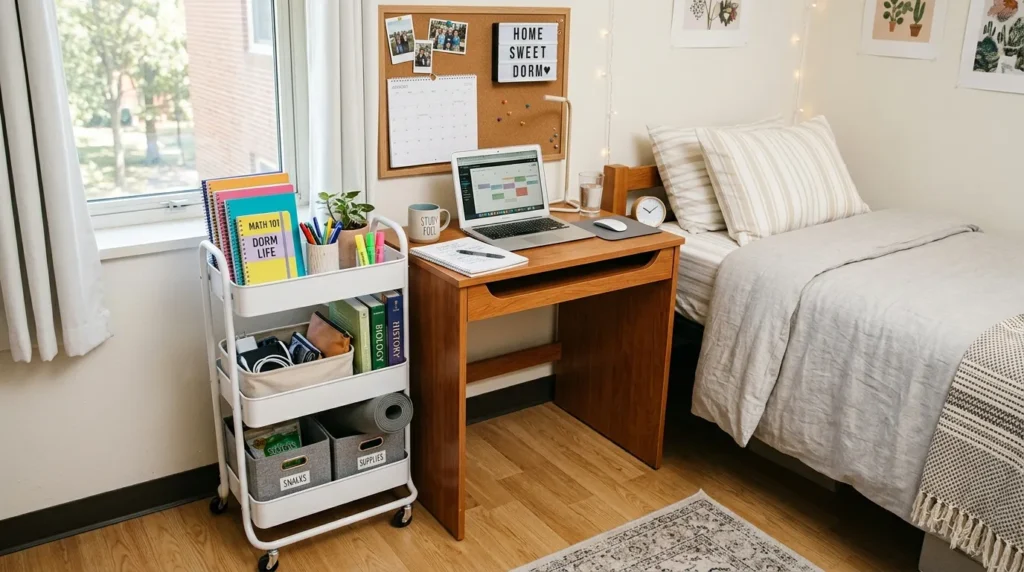
A narrow rolling cart can take advantage of spaces that are too small for conventional furniture.
It can fit beside a desk, between furniture pieces, next to a bed, or in a closet depending on the layout.
The advantage is flexibility. A cart can store school supplies during the week, move near the bed when needed, or serve as a snack and drink station.
How To Style It
Assign one category to each level.
For example:
- Top: everyday supplies
- Middle: notebooks and accessories
- Bottom: less-used items
Use small containers to prevent loose objects from spreading across the shelves.
If you want the cart to feel decorative as well as practical, coordinate its containers with the rest of your room.
Choose a narrow model that leaves enough clearance for walking and opening drawers.
6. Desk Organization

Quick Benefits
- Preserves valuable workspace
- Makes studying easier
- Reduces visual clutter
- Keeps supplies accessible
- Helps small desks work harder
Why It Works
A dorm desk has to serve multiple purposes. It may be a study area, computer station, makeup space, snack area, and sometimes even a place for storing belongings.
That makes desk organization especially important.
The goal is to keep the working surface mostly clear while moving smaller items upward, underneath, or into containers.
A cluttered desk can also make a small room feel even smaller because it creates a large visual concentration of objects.
How To Style It
Keep only the supplies you use frequently on the desktop.
Use a vertical file holder for papers and notebooks.
A small cup or organizer can hold pens and frequently used tools.
Use cable clips or an appropriate cable-management system to keep charging wires under control.
If you need additional storage, consider a compact drawer unit or rolling cart that can fit beneath or beside the desk.
7. Hanging Closet Solutions
Quick Benefits
- Increases usable closet height
- Keeps clothing organized
- Reduces floor clutter
- Makes small closets easier to manage
- Helps separate categories
Why It Works
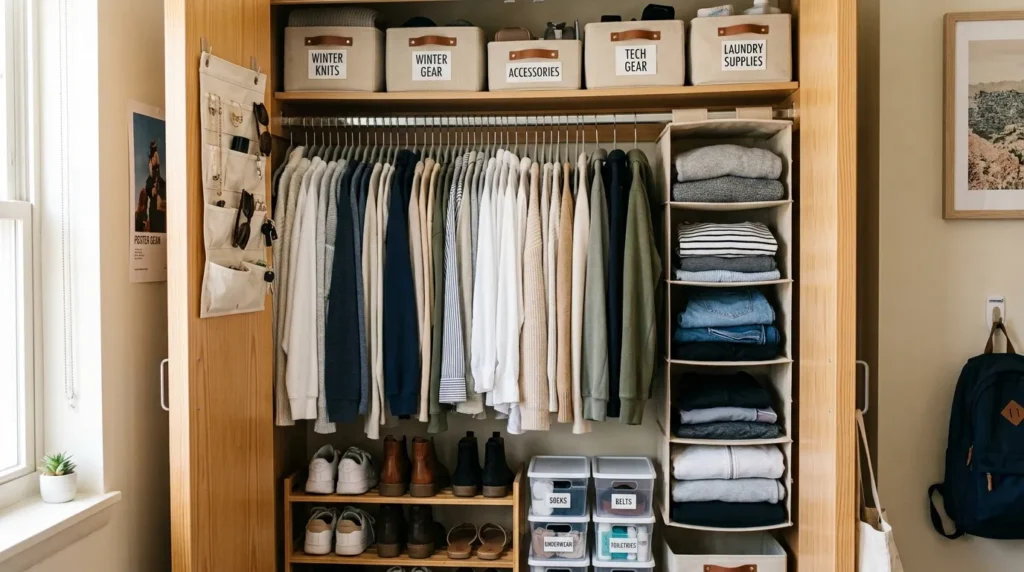
Dorm closets are often limited in both width and depth, so using the vertical space inside them can make a significant difference.
Hanging organizers can create additional levels for folded clothing, shoes, accessories, or bags.
You can also organize clothing by category rather than simply placing everything wherever there is space. This makes it easier to find what you need and encourages the system to stay organized.
How To Style It
Use slim hangers where permitted to reduce wasted space.
Add a hanging shelf organizer for sweaters, folded shirts, or accessories.
Keep frequently worn clothing in the easiest-to-reach section.
Place seasonal clothing and less-used belongings toward the back or higher sections.
Do not overload closet rods or hanging organizers beyond their weight capacity.
8. Multiuse Furniture
Quick Benefits
- Reduces the number of furniture pieces
- Makes small rooms more flexible
- Combines storage and function
- Can create additional seating
- Helps maximize limited floor space
Why It Works
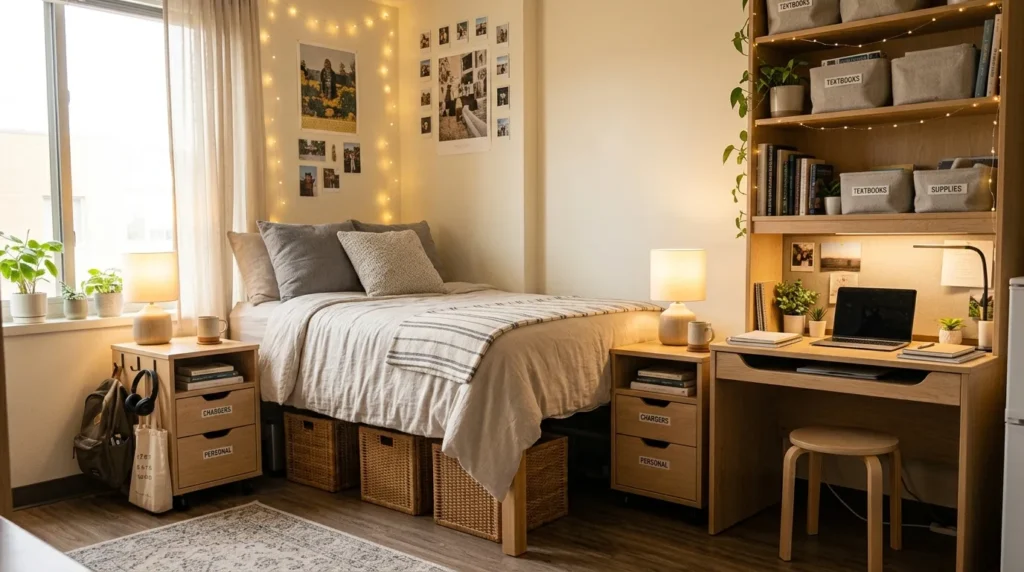
In a small room, every piece of furniture occupies valuable floor area. Choosing something that performs two jobs can therefore be more useful than buying two separate pieces.
Examples include an ottoman that provides seating and storage, a bedside table with drawers, or a storage bench that can also serve as seating.
Dorm furniture is often provided by the school, so your ability to add pieces may be limited. Always consider room dimensions and housing rules before bringing in additional furniture.
How To Style It
Look for pieces that solve a specific problem.
If you need seating and storage, a compact storage ottoman may accomplish both.
If you need a bedside surface, choose a narrow table with a shelf or drawer where permitted.
Keep the furniture visually simple so the room does not feel crowded.
Avoid adding multifunctional pieces simply because they seem clever. If you do not need both functions, the extra furniture may not be worth the floor space.
9. Foldable Storage
Quick Benefits
- Saves space when not in use
- Useful for seasonal belongings
- Easy to transport
- Works well in temporary housing
- Helps during move-out
Why It Works
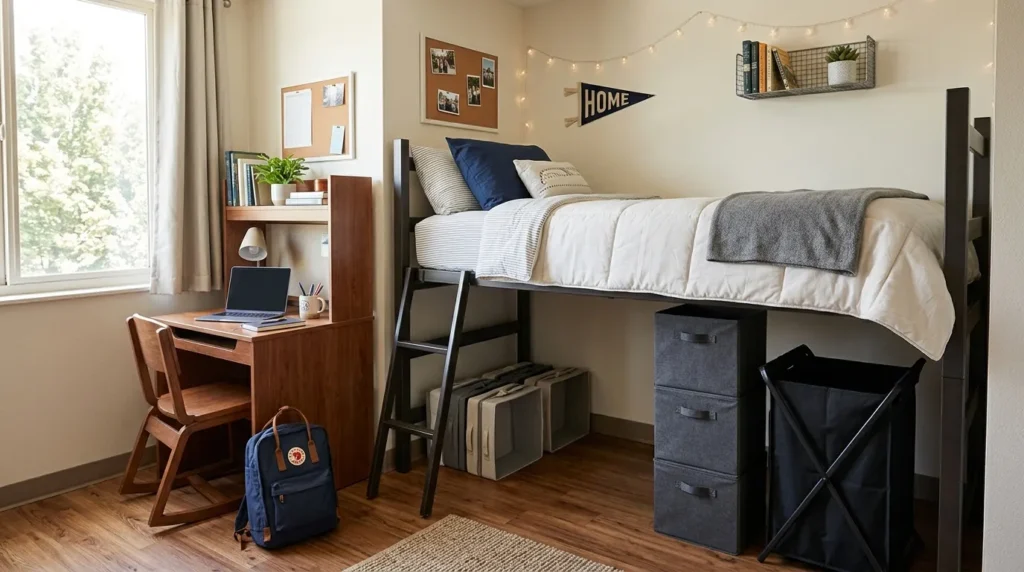
Dorm living is temporary, and students often accumulate belongings throughout the semester. Foldable storage can be particularly useful because it can be collapsed when empty.
Fabric cubes, collapsible laundry hampers, folding boxes, and other flexible containers can adapt as your storage needs change.
This is also helpful at the end of the school year because collapsible items take up less space during transportation.
How To Style It
Use collapsible bins for clothing, bedding, or miscellaneous items.
Choose a few consistent sizes rather than many different containers.
Label them so you know what is inside.
Keep empty bins folded and stored inside larger containers or beneath the bed.
Avoid buying large quantities before you know how much storage you actually need.
10. Bedside Caddies
Quick Benefits
- Replaces a bulky nightstand
- Keeps essentials within reach
- Saves floor space
- Works well in shared rooms
- Helps organize nighttime items
Why It Works
A traditional nightstand can consume valuable floor space, particularly beside a narrow dorm bed.
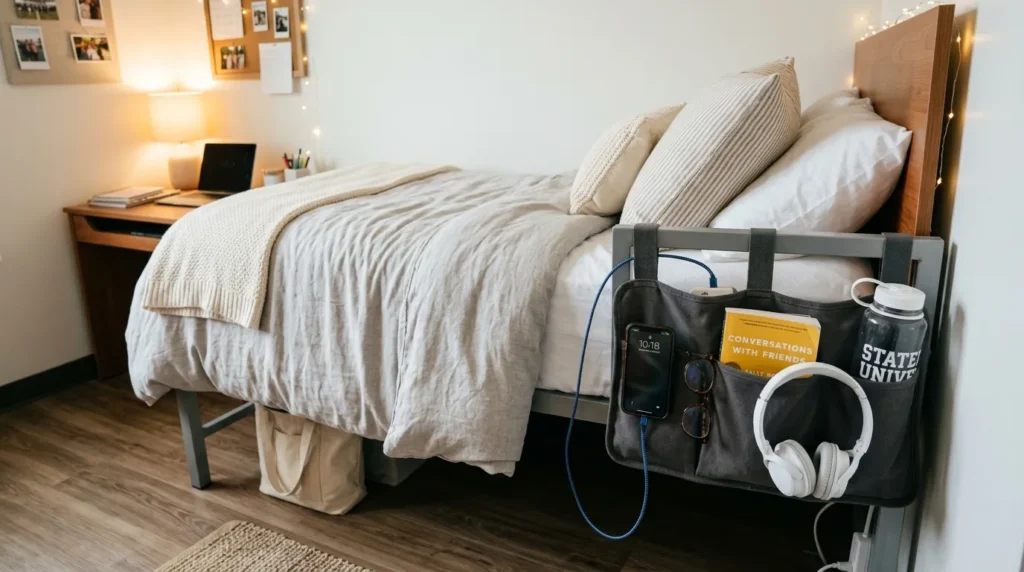
A bedside caddy can provide a compact alternative for items you want close at night, such as a phone, glasses, headphones, book, charger, or water bottle.
This solution is especially helpful in rooms where the bed is positioned against a wall or where there is little room between the bed and another piece of furniture.
How To Style It
Choose a caddy with separate compartments for different categories.
Keep the items inside limited to what you actually use.
Use a dedicated compartment for charging cables so they do not become tangled.
If your bed frame or mattress setup does not safely support a caddy, use another compact storage option instead.
The best bedside storage should be convenient without interfering with the bed’s structure or safety.
11. Roommate Zone Planning
Quick Benefits
- Reduces shared-room conflicts
- Creates clearer storage boundaries
- Makes cleaning easier
- Improves everyday organization
- Helps both people use the room comfortably
Why It Works
When two people share a small room, organization becomes a shared design problem.
Even a well-organized dorm can feel chaotic if belongings spread into each other’s areas.
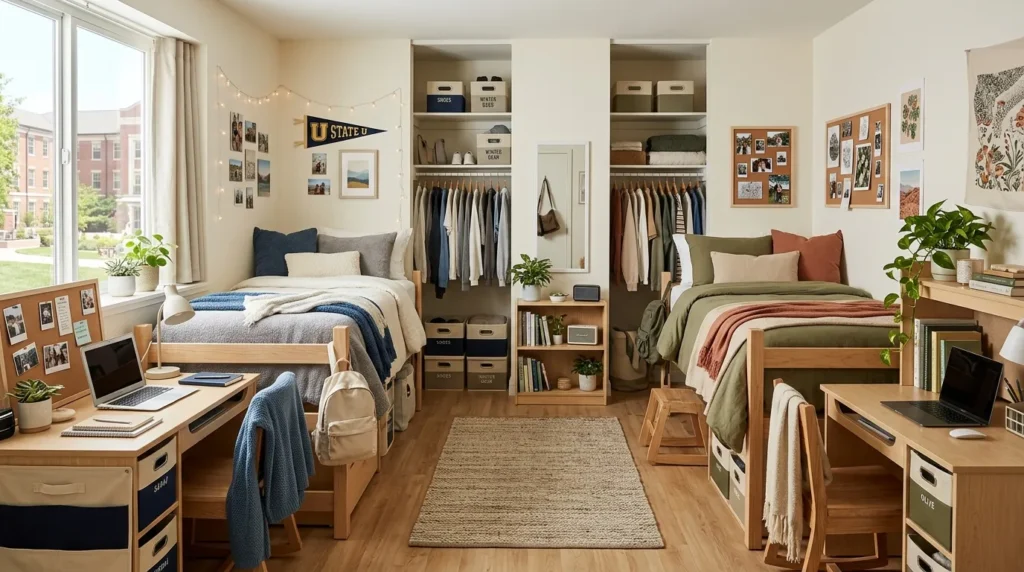
Creating clear zones gives each person a defined place for clothing, school supplies, shoes, bags, and personal items.
You can also divide shared areas, such as the center of the room or closet shelves, so expectations are clear.
How To Style It
Begin by identifying which storage belongs to each person.
Use matching or complementary bins so the room still looks cohesive.
Assign specific shelves or drawers to each roommate.
Keep shared items together in one clearly defined location.
If one person owns significantly more belongings, discuss storage before the room becomes overcrowded.
A simple agreement about shared surfaces, cleaning, and storage can make a small room much easier to live in.
Frequently Asked Questions
How do I maximize space in a small dorm room?
Start by using spaces that are often overlooked: underneath the bed, behind doors, inside closets, and vertically along walls where permitted. Choose storage that serves a specific purpose and prioritize items you use frequently. Keeping floor space open is particularly important because a clear walking area can make a small dorm feel considerably less crowded.
What should I store under my dorm bed?
Under-bed storage is ideal for belongings you do not need constantly, such as seasonal clothing, extra bedding, shoes, luggage, towels, and decorations. Use low-profile containers that can slide out easily and label them clearly. Keep frequently used items toward the front so you do not have to remove multiple containers whenever you need something.
How can I organize a dorm room without damaging the walls?
Check your school’s housing rules before installing anything. Depending on the dorm, removable hooks, freestanding organizers, tension systems, over-door storage, and other non-permanent solutions may be appropriate. Do not assume a particular adhesive or wall product is permitted. Housing guidelines should always take priority.
How can I make a dorm room look less cluttered?
Reduce visual clutter by grouping similar items together and giving belongings designated homes. Use matching or coordinated storage containers, keep the desktop relatively clear, and avoid covering every available surface with decorations. Leaving some open floor and wall space can make the room feel more spacious even when the amount of storage has not changed.
Are rolling carts good for dorm rooms?
A narrow rolling cart can be very useful because it provides multiple levels of storage while occupying relatively little floor space. It can hold school supplies, snacks, toiletries, or electronics. Before buying one, measure the narrow spaces around your furniture and make sure the cart can move without blocking drawers, doors, or walking paths.
How can two roommates organize one small room?
Divide personal storage areas clearly and decide which spaces are shared. Assign specific drawers, closet sections, shelves, or under-bed areas to each person. Use similar storage containers to keep the room visually cohesive. It also helps to agree on shared surfaces and cleaning responsibilities before clutter becomes a problem.
What should I avoid when organizing a dorm room?
Avoid buying large amounts of storage before measuring the room and understanding what furniture your dorm already provides. Oversized furniture, too many decorative containers, and storage that blocks doors or walking paths can make the room less functional. Also avoid exceeding the weight limits of shelves, hanging organizers, beds, or other furniture.
Conclusion
A small dorm room does not have to feel permanently crowded. The most effective approach is to think vertically and look for storage opportunities that do not consume additional floor space.
Start underneath the bed, where seasonal clothing, extra bedding, shoes, and luggage can often be stored. Then look at the back of doors, closet height, desk space, and narrow gaps that could accommodate a compact rolling cart.
If your dorm allows an approved lofted bed, the area underneath can become a useful study or storage zone. Multifunctional furniture can also reduce the number of individual pieces you need, while foldable storage makes moving and end-of-year packing easier.
For shared rooms, organization is just as much about communication as storage. Clearly defined roommate zones can prevent belongings from gradually spreading across the entire room.
You also do not need to turn your dorm into a storage system with no personality. Choose containers, bedding, lighting, and accessories that reflect your style while keeping everyday essentials accessible.
Before purchasing anything, measure twice. Check the dimensions of your bed, closet, desk, doors, and available floor areas. Also review your school’s housing policies, particularly when considering wall-mounted storage, lofting, or additional furniture.
The best dorm room organization is not the system with the most containers. It is the one that makes everyday life easier while leaving enough room to study, sleep, relax, and actually enjoy your space.
Related Articles
- Small Bedroom Storage Ideas That Maximize Every Inch
- Cozy Dorm Room Ideas for a More Comfortable Space
- College Dorm Room Organization Ideas for Students
- Small Bedroom Ideas for Better Storage and Style
- Desk Organization Ideas for a Clutter-Free Study Space